

Is Shopify Plus worth the extra cost?
Shopify Plus is Shopify’s enterprise plan for high-growth and complex merchants. It costs more than Advanced, and it is worth that premium when you need Plus-only capabilities or when lower card rates and operational features repay the subscription. It is not worth it when Advanced already covers your checkout, staff, and B2B needs.
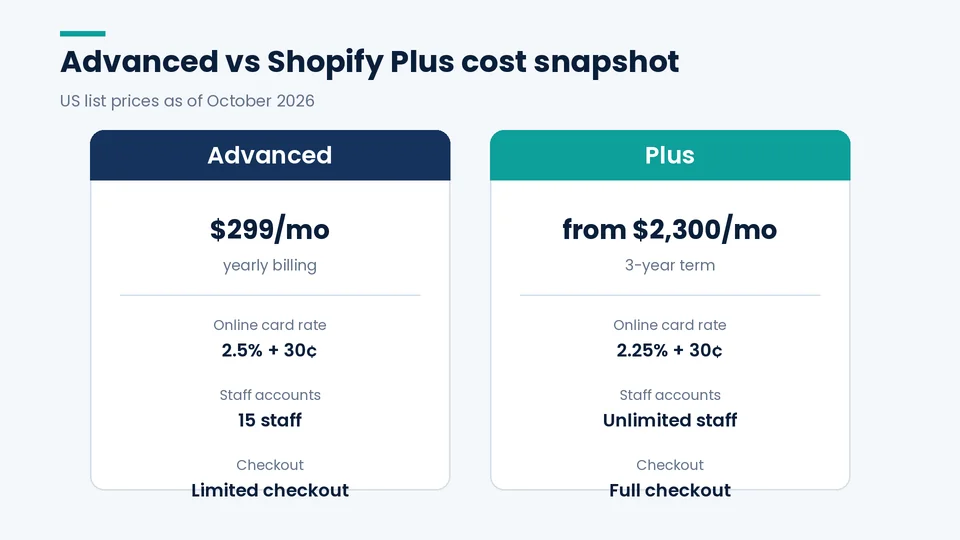
As of October 2026, Shopify lists Plus from $2,300 per month on a three-year term or $2,500 per month on a one-year term on shopify.com/plus/pricing, with a variable platform fee for more complex, higher-volume businesses. Advanced sits at $299 per month on yearly billing or $399 monthly on shopify.com/pricing. At PROSeCommerce, part of PROS Global, a San Diego Shopify and Magento agency, we treat Plus as a capability buy first and a rate buy second.
This article focuses on ROI and timing. For a feature-by-feature Advanced vs Plus breakdown, use our dedicated comparison: Shopify Advanced vs. Plus. For the full plan ladder, see Shopify plans explained.
What you pay for on Plus
Plus pricing is a platform fee plus payment economics that improve with volume. The sticker alone does not decide ROI; the feature gate and card rates do.
From Shopify’s Plus pricing page and the main pricing comparison table as of October 2026:
| Item | Advanced | Shopify Plus |
|---|---|---|
| Platform fee | $299/mo yearly ($399 monthly) | From $2,300/mo (3-year) or $2,500/mo (1-year); variable for complex setups |
| Online standard card rate | 2.5% + 30¢ | 2.25% + 30¢ |
| Third-party gateway fee | 0.6% | 0.2% |
| Staff accounts | 15 | Unlimited |
| B2B catalogs | Up to 3 | Unlimited |
| Inventory locations | 10 | 200 |
| Checkout customization | Limited | Full |
| API rate limits | Up to 2x on select APIs | Up to 10x on select APIs |
| Headless storefronts | 1 | 25 |
| Expansion stores | Not in the Advanced column | Main store + 9 included; more at $300/mo or revenue share |
| POS Pro | $89/mo per location | 20 locations included (up to 200 with Shopify Payments per pricing table) |
Plus-only commercial tools Shopify highlights include B2B on Shopify at scale, checkout customizations, Shopify Functions, Shopify Audiences, ShopifyQL Notebooks, Managed Markets capabilities, and headless options. If none of those are on your twelve-month roadmap, Advanced is usually the better home.
When Plus pays for itself on rates alone
Rate savings can offset part of the Plus premium when card volume is high. They rarely cover the entire jump from Advanced by themselves at mid-market volumes, which is why feature need still matters.
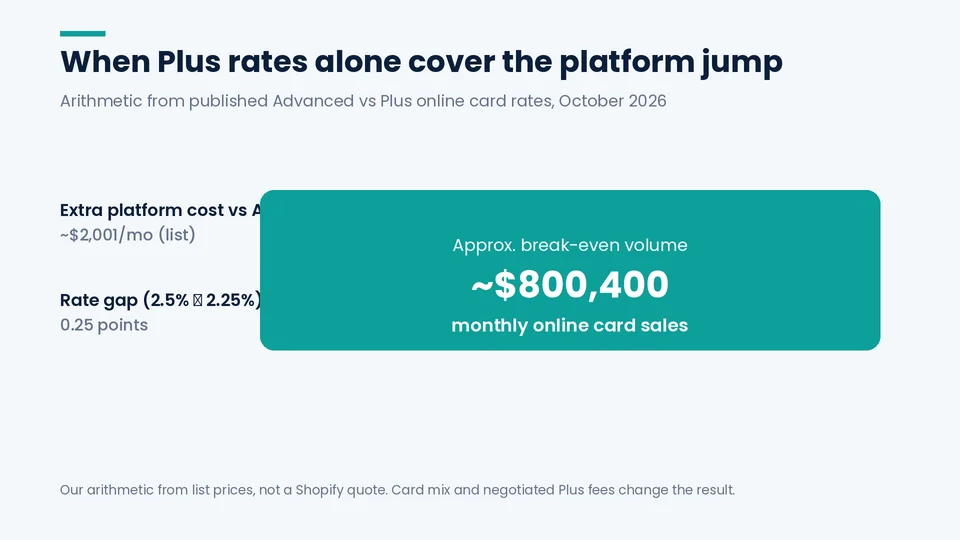
Rough arithmetic using standard online Shopify Payments rates as of October 2026:
- Advanced online rate: 2.5% + 30¢
- Plus online rate: 2.25% + 30¢
- Rate gap: 0.25 percentage points
Extra platform cost versus Advanced on yearly billing: about $2,300 − $299 = $2,001 per month on the Plus three-year list price (actual contracts can differ).
Break-even on rate gap alone ≈ $2,001 / 0.0025 ≈ $800,400 in monthly online card volume.
That figure is our arithmetic from published list prices, not a Shopify quote. Premium cards, international surcharges, in-person rates, and negotiated Plus terms change the result. If you use a third-party primary gateway, Shopify’s Plus fee is 0.20% per transaction versus 0.6% on Advanced, which widens savings for non–Shopify Payments setups.
Most merchants who move to Plus do it because they need checkout control, B2B scale, expansion stores, or API headroom before pure rate math clears. Rate savings then become a bonus, not the sole business case.
Capability triggers that justify Plus sooner
Upgrade when a required capability is blocked on Advanced. These triggers are clearer than vanity metrics like “we want to look enterprise.”
Full checkout customization. If brand or conversion requirements need checkout UI extensions and deeper payment-page control, Plus is the plan Shopify documents for full checkout customization.
Unlimited B2B catalogs. Advanced caps B2B catalogs at three. Wholesale programs with many price lists often need Plus.
Expansion stores. International or regional storefronts under one Plus contract can be cheaper and cleaner than separate stacks. Shopify includes the main store plus nine expansion stores in the platform fee, with additional stores at $300 per month or a revenue share, per the Plus pricing FAQ as of October 2026.
Shopify Functions and custom commerce logic. Discount, shipping, and payment logic that must run as Functions is a Plus-oriented path for custom apps containing Function APIs.
API and headless scale. Higher API limits and more Hydrogen storefronts matter for ERP-heavy or headless architectures.
Operational support and tooling. Priority support, Audiences, and Notebooks can matter for teams already spending heavily on ads and analytics ops.
If your pain is mainly theme speed or SEO hygiene, fix those on Advanced first. Our guides on speeding up a Shopify store and the Shopify SEO checklist address problems Plus will not magically solve.
When staying on Advanced is the smarter ROI
Advanced is enough for many high-volume single-brand stores. Staying put protects margin when Plus features would sit unused.
Stay on Advanced when:
- Fifteen staff accounts are enough.
- Three B2B catalogs cover wholesale.
- Limited checkout customization meets legal and UX needs via apps and theme work.
- You are not launching expansion stores in the next year.
- Card volume is well below the rate break-even band above.
- The team still needs to stabilize apps, data quality, and merchandising ops.
Also pause if Magento still fits a complex mid-office better than a rewrite. Our Shopify Plus vs. Magento piece covers that platform fork. Migrating only to access Plus branding, without a capability map, is an expensive vanity project.
Soft costs people forget
Plus ROI includes people and process, not only Shopify’s invoice. Budget implementation partners, QA on checkout extensibility, B2B buyer UX testing, and training for staff who will use new admin surfaces. Shopify’s Plus pricing FAQ notes that Shopify does not charge a migration fee itself, but paid services and partner work are common for complex moves.
Contract term matters. One- and three-year Plus commitments differ from the flexible upgrades on Basic through Advanced. Cancel timing follows the term, per Shopify’s pricing FAQ as of October 2026. Model the commitment window before you sign.
Apps can go down after a Plus build if Functions and native B2B replace multiple subscriptions. Include those cancellations as savings in the business case, with a conservative lag for overlap during cutover.
A simple Plus decision checklist
Use this with finance and operations in the same meeting:
- List Plus-only features you will use in the next 12 months.
- Estimate monthly online card volume and whether Shopify Payments is primary.
- Run the rate math with your actual card mix.
- Price partner implementation and a 90-day hypercare retainer.
- Subtract app cancellations you can prove.
- Compare the net monthly cost to the revenue or margin gained from the Plus-only capability (for example, wholesale conversion or checkout lift). Use conservative assumptions.
- If the capability is mandatory and Advanced cannot deliver it, Plus can be correct even when rate math alone fails.
PROSeCommerce runs this checklist before recommending Plus on migrations or upgrades. We will say stay on Advanced when the feature map does not support the spend.
ROI narrative finance teams accept
Finance usually wants three numbers: incremental platform cost, incremental payment savings, and incremental gross profit from capabilities you cannot get on Advanced. Put them on one page with dated sources. Cite Shopify’s pricing pages with “as of October 2026” so the sheet does not go stale silently.
Avoid mixing one-time migration spend into the monthly ROI without calling it out. Implementation is a project cost; the subscription is ongoing. A clean model shows payback months for the project and a steady-state monthly comparison afterward.
If wholesale is the driver, estimate margin on wholesale orders that are impractical today, not top-line GMV. If checkout customization is the driver, use a conservative conversion lift range and label it as a planning assumption, not a promise. Merchants who need broader SEO and conversion fundamentals should fix those on the current plan in parallel; Plus will not replace weak product pages or slow scripts.
For merchants comparing platform fee pain to Magento ownership costs, include security patches, hosting, and specialized developer scarcity on the Magento side. That comparison often flips when internal Magento talent is thin.
Common myths about Plus value
Myth: Plus is required past a revenue number. Shopify does not publish a hard GMV gate on the public Plus pricing page. Capability and contract fit matter more than a round revenue figure from a blog.
Myth: Plus automatically makes the site faster. Performance still depends on theme, apps, and media. Plus infrastructure helps at extreme checkout volume, but everyday LCP issues are usually theme and script problems.
Myth: You should buy Plus to access “better SEO.” Indexing and on-page quality are mostly operational. Use the Shopify SEO checklist and ecommerce SEO tips before treating Plus as an SEO purchase.
Myth: Advanced is only for small stores. Advanced already includes lower card rates than Grow, fifteen staff, and live carrier rates. Many serious brands should stay there longer than Twitter threads suggest.
Frequently asked questions about Shopify Plus value
Is Shopify Plus worth it for a small business?
How much does Shopify Plus cost?
When should I upgrade from Advanced to Plus?
Does Shopify Plus include unlimited stores?
Is Plus cheaper than Magento overall?
Can I try Shopify Plus before committing?
Pay for Plus only when you will use Plus
Shopify Plus is worth the extra cost when a Plus-only capability opens revenue or removes a hard Advanced limit, and when you have budgeted implementation honestly. It is the wrong upgrade when Advanced already fits and the main motive is a lower card rate that will not cover the platform jump.
If you want a Plus versus Advanced review grounded in your volume and roadmap, contact PROSeCommerce via Shopify development services. Bring last-quarter card volume, the checkout or B2B requirements you cannot meet today, and whether expansion stores are on the calendar. That package is enough for a clear yes, no, or not yet.