
Keeping leads engaged: an overview
A sales funnel is the path a person takes from first hearing about your business to buying and, ideally, buying again. Most funnels have four stages, often called awareness, interest, decision and action, plus a retention stage after the sale. Keeping leads engaged means giving people the right content at each stage, following up quickly, and measuring where they drop out so you can fix that step first.
This guide explains each stage, what to offer people at each one, how to keep leads engaged with email and retargeting, and how to measure your funnel in Google Analytics 4. At PROSeCommerce, part of PROS Global in San Diego, we build and improve funnels for ecommerce and service businesses, and this is the framework we use. Measurement and compliance details come from Google Analytics Help and the US Federal Trade Commission, checked as of October 2026.
What is a sales funnel?
The funnel shape shows that more people enter at the top than buy at the bottom. Some lose interest, some are not the right fit and some are not ready yet. The goal is not to push everyone through. It is to help the right people move forward and to remove anything that stops them.
A funnel is also a map. Once you can see each stage, you can see where people leave, and that tells you where to spend your time.
The stages of a sales funnel
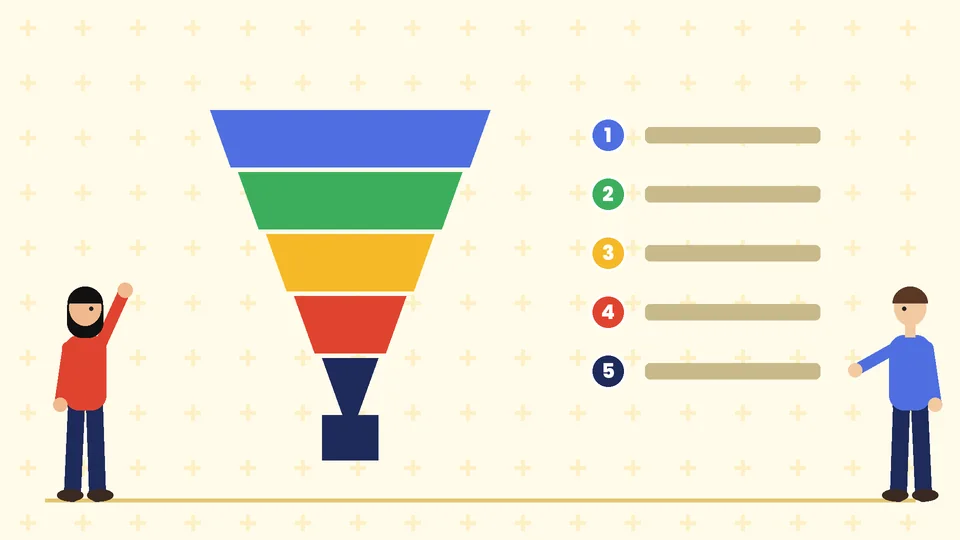
1. Awareness
People first discover you through search, social media, ads, referrals or word of mouth. At this stage they are usually looking for information, not a product.
What to offer: helpful blog posts and guides, short videos, social posts and search-friendly pages that answer their questions.
2. Interest
They want to learn more. They read more pages, follow you on social media or sign up for your emails.
What to offer: detailed guides, comparisons, product pages with clear details, and a reason to join your email list, such as a useful checklist.
3. Decision
They are comparing options and deciding whether to buy from you.
What to offer: reviews, case studies, clear pricing, shipping and returns information, demos or consultations, and answers to common objections.
4. Action
They buy, book or request a quote.
What to offer: a simple checkout or form, trusted payment options and a clear confirmation of what happens next.
5. Retention and advocacy
The funnel does not end at the sale. Customers who are happy buy again and recommend you.
What to offer: order updates, onboarding or care guides, loyalty offers, requests for honest reviews and relevant product recommendations.
Sales funnel examples
An online store
- Awareness: a shopper finds a buying guide through search or sees a short product video on social media.
- Interest: they browse the category, read a product page and sign up for emails to get a sizing checklist.
- Decision: they compare two products, read reviews and check shipping and returns.
- Action: they add an item to the cart and complete a short checkout. If they leave, a cart reminder email brings them back.
- Retention: they get shipping updates, a care guide and, a few weeks later, a relevant product suggestion and a request for an honest review.
A service business
- Awareness: a business owner reads a how-to article or sees a local search result.
- Interest: they download a checklist or watch a short explainer and join the email list.
- Decision: they read case studies, look at pricing and book a call.
- Action: they receive a clear proposal and sign.
- Retention: a welcome plan, regular reports and check-ins lead to renewals and referrals.
Offers that move leads to the next stage
A good offer gives people a reason to take the next small step. Match it to the stage:
| Stage | Example offer | Next step you want |
|---|---|---|
| Awareness | A short guide or video that answers a common question | Visit another page or follow you |
| Interest | A checklist, sizing guide or email course | Join your email list |
| Decision | Reviews, a comparison chart, a demo or a consultation | Add to cart or book a call |
| Action | Clear pricing, shipping and returns, and simple payment | Complete the purchase |
| Retention | Care tips, loyalty rewards and product suggestions | Buy again or leave a review |
Keep every offer honest. If you promise a discount or free shipping, make the terms clear before checkout.
How to keep leads engaged at every stage
Follow up quickly
When someone fills in a form or asks a question, respond as soon as you can. A slow reply gives them time to choose someone else.
Use automated email flows
Email works well for nurturing because it reaches people who already asked to hear from you. Common flows include:
- A welcome series for new subscribers
- A browse or cart reminder for people who left without buying
- A post-purchase series with care tips and related products
- A win-back email for customers who have not bought in a while
Every commercial email must follow the CAN-SPAM Act. The FTC’s compliance guide says you must not use misleading header information or subject lines, must identify the message as an ad, must include a valid physical postal address and must honor opt-out requests within 10 business days. Each separate email in violation can cost up to $53,088.
Segment your audience
Send different messages to people at different stages. A first-time visitor does not need a loyalty offer, and a repeat customer does not need a basic introduction.
Retarget with care
Retargeting ads remind people who visited your site of what they viewed. Limit how often they see the same ad and stop showing it once they buy.
Build trust with honest proof
Reviews and testimonials help people decide, but they must be real. The FTC’s Consumer Reviews and Testimonials Rule, in effect since October 21, 2024, bans fake reviews and testimonials, and the FTC’s Endorsement Guides require clear disclosure when an endorser has a material connection to your business, such as being paid or receiving free products.
This is general information, not legal advice.
How to measure your sales funnel
You cannot improve what you do not measure. Google Analytics 4 has tools built for this.
Mark the actions that matter as key events
In GA4, mark important actions such as purchases, form submissions or sign-ups as key events. For stores, Google recommends ecommerce events such as view_item, add_to_cart, begin_checkout and purchase, which map neatly to funnel stages.
Build a funnel exploration
GA4’s funnel exploration report shows how many people complete each step and where they drop off. According to Google Analytics Help, you can:
- Define up to 10 steps
- Choose an open funnel, where people can enter at any step, or a closed funnel, where they must start at the first step
- Compare up to 4 segments, such as mobile versus desktop
- See a trended funnel over time, the elapsed time between steps and the next action people take after a step
Tag your campaigns
Add UTM parameters to links in emails, social posts and ads so you can see which sources bring people who go on to buy.
Fix the biggest drop first
Look for the step with the largest drop-off and start there. If many people add to cart but few begin checkout, look at shipping costs and cart design. If many begin checkout but few finish, simplify the form and payment options.
| Stage | Example GA4 event | What a big drop may mean |
|---|---|---|
| Awareness to interest | page_view to view_item | Content does not match what people searched for |
| Interest to decision | view_item to add_to_cart | Product pages lack detail, price or trust signals |
| Decision to action | begin_checkout to purchase | Checkout is too long or costs are a surprise |
| Action to retention | purchase to repeat purchase | Little follow-up after the first order |
Tools to run your funnel
You do not need a large tech stack. Most small businesses can run a working funnel with:
- Your website or store, with clear product or service pages and a simple checkout or contact form
- An email platform that supports sign-up forms, segments and automated flows
- Google Analytics 4, set up with key events and ecommerce events
- Google Search Console, to see which searches bring people to the top of the funnel
- A simple CRM or spreadsheet for service businesses, to track each lead and the next follow-up
Connect them so that a sign-up, a purchase or a booked call is recorded in one place, and review the numbers on a set schedule, such as monthly.
Common sales funnel mistakes
- Treating every lead the same. Match the message to the stage.
- No follow-up after the sale. Retention is often the cheapest growth.
- Measuring only traffic. Visits matter less than the steps people complete.
- Changing everything at once. Change one step at a time so you know what worked.
- Ignoring mobile. Many people move through the early stages on a phone, so test forms, product pages and checkout on a small screen.
- Overpromising. Claims you cannot back up damage trust and can break advertising rules.
Frequently asked questions
What are the stages of a sales funnel?
How do I keep leads engaged?
What is the difference between a sales funnel and a marketing funnel?
How do I measure a sales funnel in Google Analytics 4?
What is an open versus closed funnel in GA4?
Which stage of the funnel should I fix first?
Build a funnel that works
A clear funnel turns scattered marketing into a path customers can follow. Use our guide to how to increase ecommerce sales to improve the decision and action stages, and our six ways to get more website traffic to fill the top. If you would like help mapping or fixing your funnel, contact PROSeCommerce.