
What is market research, and how does it connect to marketing concepts?
Market research is the process of collecting and analyzing information about customers, competitors and the market so you can make better business decisions. Marketing concepts are the ideas that turn that information into a plan: who you serve, what you offer, how you price it, where you sell it and how you promote it. Research tells you what is true about your market; marketing concepts tell you what to do about it.
The American Marketing Association defines marketing research as the function that links consumers, customers and the public to the marketer through information used to identify opportunities and problems, evaluate actions and monitor performance. This guide covers the questions market research should answer, the main research methods, free data you can use, how to run a competitive analysis and the core marketing concepts that put the findings to work. At PROSeCommerce, part of PROS Global in San Diego, we use this process before planning campaigns for online stores.
The questions market research should answer
The U.S. Small Business Administration’s guide to market research and competitive analysis lists the basic questions a business should be able to answer:
- Demand: Is there a desire for your product or service?
- Market size: How many people might be interested in what you offer?
- Economic indicators: What are income levels and employment rates in your market?
- Location: Where do your customers live, and where can your business reach them?
- Market saturation: How many similar options are already available?
- Pricing: What do potential customers currently pay for these products or services?
If you cannot answer these, you are guessing at your marketing. Even rough answers backed by data are better than assumptions.
Primary vs. secondary research

Research falls into two groups.
| Primary research | Secondary research | |
|---|---|---|
| What it is | Data you collect yourself | Data others have already collected |
| Examples | Surveys, interviews, focus groups, test ads, customer feedback | Government statistics, industry reports, competitor sites, search trends |
| Cost | Time and sometimes incentives or tools | Often free or low cost |
| Strength | Specific to your customers and product | Fast, broad view of the market |
| Weakness | Takes time; small samples can mislead | Not tailored to your exact question |
The SBA describes this split as using existing sources or doing direct research yourself through surveys, questionnaires, focus groups and in-depth interviews. Most small businesses start with secondary research to size the market, then use primary research to test specific ideas.
Primary research methods
- Surveys. Short online surveys sent to customers, email subscribers or a panel. Keep them to a few questions, and ask about behavior (“How did you buy this last time?”) more than opinions.
- Customer interviews. Fifteen- to thirty-minute conversations with current or lost customers. They show why people buy, what almost stopped them and the words they use.
- Focus groups. A moderated discussion with a small group. Useful for reactions to packaging, names or ads, but group opinions can drift toward the loudest voice.
- Test campaigns. A small paid ad test or landing page shows real behavior, such as clicks, sign-ups and sales, rather than stated intent.
- Feedback you already have. Reviews, support tickets, returns reasons and on-site search terms are free primary data.
Secondary research sources
- Government data. Free federal data on population, income, businesses and prices (see the next section).
- Search and trend data. Google Trends shows relative search interest over time and by region, which helps you spot seasonality and rising topics.
- Competitor websites and marketplaces. Product ranges, prices, reviews and shipping policies are visible to anyone.
- Industry associations and trade publications. Many publish market overviews, member surveys and event reports.
Free federal data for market research
The SBA points businesses to free federal statistics. Some of the most useful are:
- Census Business Builder: a Census Bureau tool with maps, a dashboard and downloadable reports that combine demographic and business data for a chosen location and business type.
- County Business Patterns: counts of business establishments, employment and payroll by industry and area, useful for judging how crowded a local market is.
- Bureau of Labor Statistics data: employment, wages and the Consumer Price Index, available at bls.gov.
- Bureau of Economic Analysis data: regional income and spending figures at bea.gov.
For an online store, combine these with your own analytics. Census data can tell you where likely customers live; your store data tells you which of them actually buy.
How to run a competitive analysis
The SBA suggests a competitive analysis covering who your competitors are, their market share, their strengths and weaknesses, the window of opportunity to enter the market, the importance of your target market to competitors and any barriers that could stop you from entering. In practice, for a small business:
- List direct and indirect competitors. Direct ones sell the same thing to the same buyers; indirect ones solve the same problem another way.
- Compare offers side by side. Price, product range, shipping, returns, reviews and guarantees.
- Review their marketing. Which keywords they rank or advertise for, which social channels they use and what messages they repeat.
- Read their reviews. Complaints in competitor reviews are gaps you can fill.
- Write down your difference. One or two clear reasons a buyer would choose you.
Core marketing concepts
Once you have research, marketing concepts help you organize decisions. The AMA defines marketing as the activity, set of institutions and processes for creating, communicating, delivering and exchanging offerings that have value for customers, clients, partners and society at large.
The marketing concept
The marketing concept is the idea that a business succeeds by finding out what customers need and meeting those needs better than competitors, rather than by making a product first and then pushing it. Textbooks often contrast it with other business orientations:
- Production orientation: focus on making products cheaply and widely available.
- Product orientation: focus on product quality and features.
- Selling orientation: focus on aggressive promotion to move what you have.
- Marketing orientation: focus on customer needs first, then build the offer around them.
- Societal marketing orientation: meet customer needs while also considering long-term effects on society.
Market research is what makes a marketing orientation possible; without it, “customer needs” are guesses.
Segmentation, targeting and positioning
- Segmentation splits a market into groups with shared traits, such as location, age, income, behavior or needs.
- Targeting picks the segments you can serve best and profitably.
- Positioning decides how you want those targets to see you compared with competitors, such as the affordable option, the premium option or the specialist.
Your research data feeds each step. Census and BLS figures help define segments by area and income; interviews and reviews show which needs matter most.
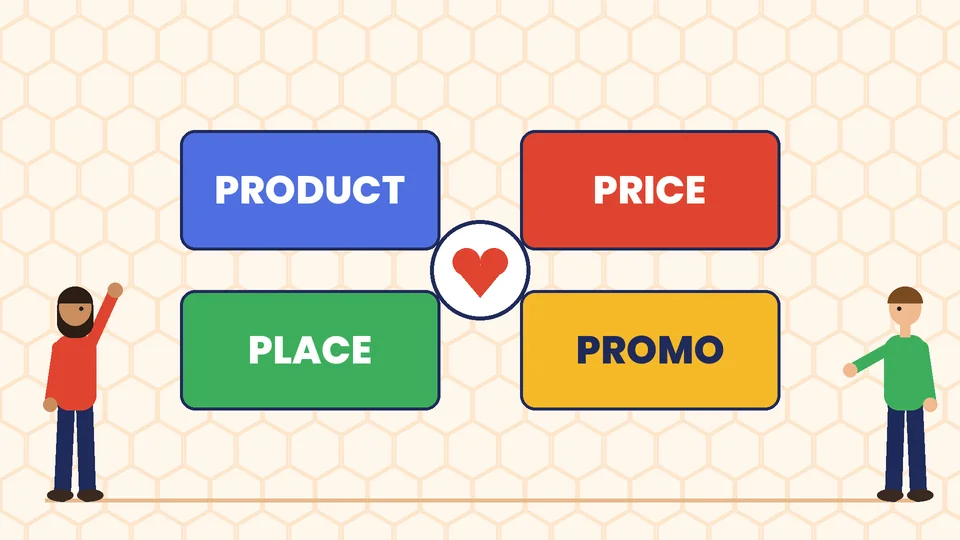
The marketing mix (4 Ps)
The AMA describes the four Ps as:
- Product: a bundle of features, functions, benefits and uses, which can be a physical good, a service, an idea or a mix.
- Price: the amount a customer must pay to get the product.
- Place: distribution, or how the product reaches customers and how much of the market it covers.
- Promotion: tactics that encourage purchase, such as coupons, rebates, special packaging and, more broadly, advertising and communication.
Research should inform each P. Pricing questions from the SBA list feed price decisions, location data feeds place, and interviews show which product benefits to promote. Our guide to the types of advertising covers the promotion channels in detail.
The customer journey
Customers rarely buy on first contact. They become aware of a need, compare options, decide and, if things go well, buy again. Mapping that journey shows where research matters most, for example why people drop off between adding to cart and paying. Our article on sales funnel stages explains how to keep leads moving.
Common market research mistakes
- Asking leading questions. “Would you love a cheaper option?” gets a yes from almost everyone. Ask what people did, what they paid and what they would change.
- Surveying only fans. Current customers who like you are easy to reach, but people who chose a competitor or left your cart often teach you more.
- Trusting stated intent over behavior. Many people say they would buy and then do not. A small test ad or preorder page shows real demand.
- Using national numbers for a local business. A national market size means little to a shop that serves one county. Use county or ZIP-level data where you can.
- Researching once and stopping. Prices, competitors and search interest change. Set a calendar reminder to refresh your key numbers.
- Collecting data with no decision in mind. Start each research project with the decision it should inform, such as which product to launch or which price to test.
Turning research into a marketing plan
- Summarize what you learned on one page: who buys, why, where, at what price and against which competitors.
- Choose target segments and a positioning statement.
- Set the marketing mix for each segment.
- Pick channels and a budget, starting with those closest to purchase intent.
- Set measurable goals such as cost per sale, conversion rate or repeat purchase rate.
- Repeat research regularly, because markets, prices and competitors change.
For a broader planning framework, see our guide to building a digital marketing strategy, and for online-store tactics, our list of ecommerce marketing strategies.
Frequently asked questions
What is the difference between market research and marketing research?
What are the main types of market research?
Where can I find free market research data?
What are the 4 Ps of marketing?
What is the marketing concept?
How often should a small business do market research?
Let research guide your marketing
Good marketing starts with knowing your market. Answer the basic questions about demand, size, location, competition and price, use a mix of primary and secondary research, and then apply marketing concepts such as segmentation and the 4 Ps to build a plan you can measure. If you would like help turning research into a marketing plan for your online store, contact PROSeCommerce.