
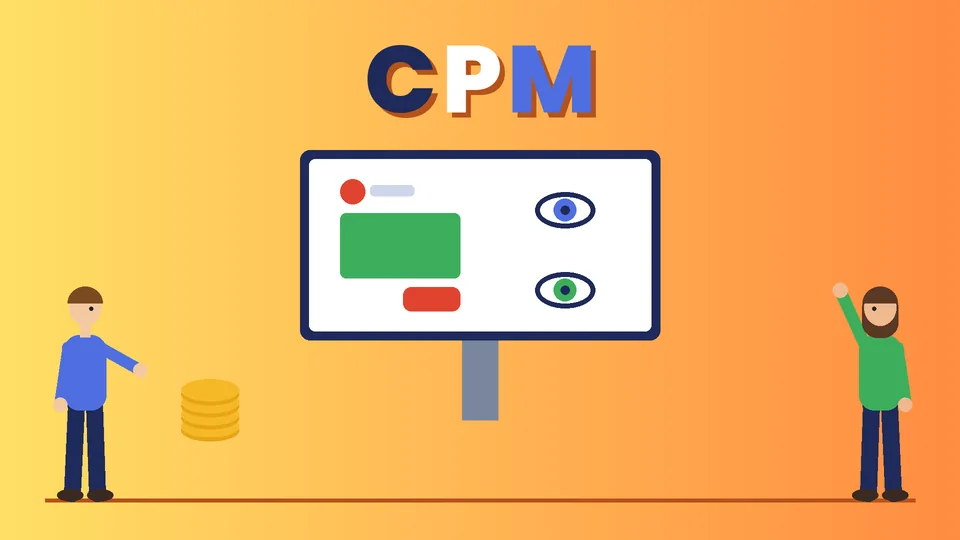
What CPM advertising is
CPM advertising is a way of buying ads where you pay for every 1,000 times your ad is shown, rather than for every click. CPM stands for “cost per mille,” mille being Latin for thousand. Google Ads Help defines cost-per-thousand impressions (CPM) as a way to bid where you pay per one thousand views on the Google Display Network, and most large ad platforms offer some form of impression-based buying.
CPM helps a business when the goal is to be seen by the right people: launching a product, building awareness in a new market or keeping a brand in front of past visitors. It is usually the wrong choice when the only goal is immediate sales at a fixed cost per order.
This refresh of our earlier post corrects the old version, which wrongly described CPM as “cost per milestone” and suggested advertisers are paid for visitors. The guide below uses Google Ads Help for definitions and bidding options, with facts checked as of October 2026 and sources listed at the end. PROSeCommerce, part of PROS Global in San Diego, plans and runs paid campaigns for Shopify and ecommerce brands, so the examples focus on online stores.
How CPM pricing works
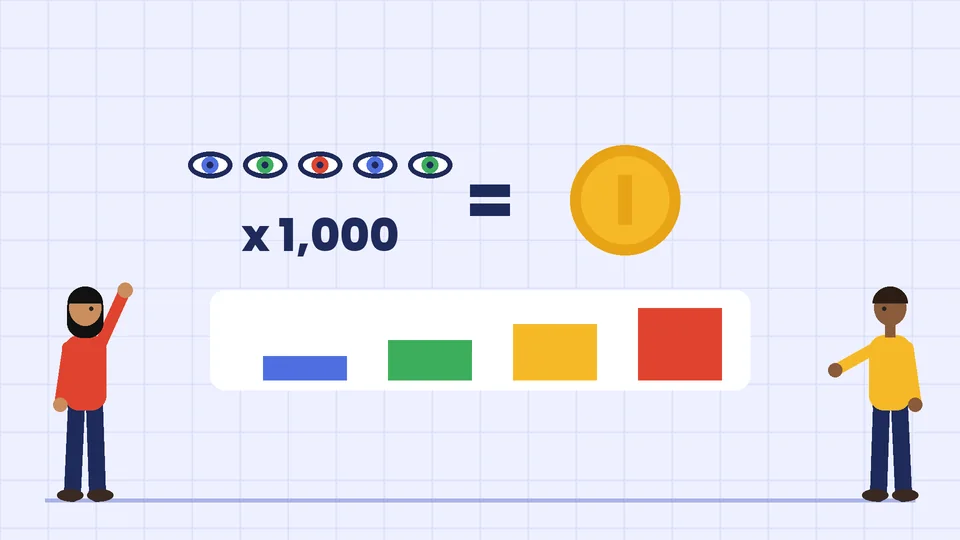
An impression is one showing of an ad. With CPM pricing, the price is set per thousand impressions, so the cost of a campaign is simple to calculate:
Cost = (impressions ÷ 1,000) × CPM
Two quick examples using round, made-up numbers:
- If you buy 200,000 impressions at a $5 CPM, you pay (200,000 ÷ 1,000) × $5 = $1,000.
- If you have a $600 budget and the average CPM is $4, you can expect about (600 ÷ 4) × 1,000 = 150,000 impressions.
You can also turn the formula around to compare campaigns that were bought differently. Effective CPM is total cost divided by impressions, multiplied by 1,000. A campaign that cost $900 and delivered 300,000 impressions had an effective CPM of $3, whether it was bought per click or per impression.
Actual CPM prices vary widely by platform, audience, placement, season and ad format, and they change from auction to auction. Treat any single “average CPM” figure you see online with caution, and use your own account data to set expectations.
Viewable CPM and why it matters
Not every impression is seen. An ad can load at the bottom of a page that nobody scrolls to, or in a tab nobody opens. That is why Google Ads moved Display bidding toward viewable CPM (vCPM).
According to Google’s page on viewability and Active View, which follows the Media Rating Council (MRC) standard:
- A display ad counts as viewable when at least 50 percent of its area is on screen for at least one second.
- For large display ads of 242,500 pixels or more, the threshold is at least 30 percent of the area for at least one second.
- A video ad counts as viewable when at least 50 percent of its area is on screen while the video plays for at least two seconds.
Google’s CPM definition notes that existing CPM bids on the Display Network are converted to vCPM automatically, so you pay only when your ad can be seen. Google also points out that Active View can tell you an ad was viewable, but it cannot guarantee a person was looking at the screen.
When you review a Display campaign, check the viewable rate alongside the CPM. A low CPM with poor viewability can be worse value than a higher CPM where most impressions are actually seen.
CPM vs CPC vs CPA
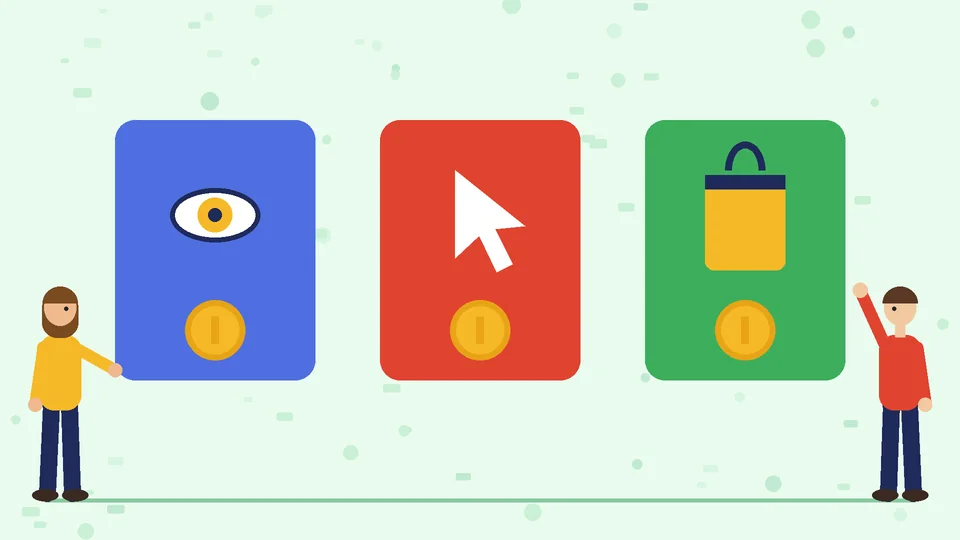
Google’s guide to choosing a bid strategy maps each pricing model to a goal. As of October 2026, it describes these options:
| Model | You pay for | Best fit |
|---|---|---|
| CPM or vCPM | Every 1,000 impressions or viewable impressions | Brand awareness and reach, where the message is in the ad itself |
| Target CPM (tCPM) | Impressions, with bids set to keep your average CPM at or below a target | Reaching as many unique people as possible within a cost target |
| CPV | Video views and interactions | Video campaigns aimed at views or consideration |
| CPC | Clicks | Driving traffic to your site |
| Target CPA or ROAS | Clicks, with bids optimized toward conversions or conversion value | Sales and leads, when conversion tracking is set up |
The practical difference is who carries the risk. With CPM, you pay for exposure, so a weak ad or a poor audience costs you money even if nobody clicks. With CPC, you pay only when someone clicks, but you may pay more per visitor. Conversion-focused Smart Bidding strategies such as Target CPA need reliable conversion tracking to work.
If you mainly buy search ads, our explainer on how Google Ads works covers the auction, Ad Rank and cost per click in detail.
When CPM advertising helps your business
Google’s guidance recommends manual vCPM bidding in situations like these:
- Your ads are designed to increase awareness, not necessarily to generate clicks.
- You are targeting specific placements, so you know the audience is a good match.
- Your message is in the ad itself, for example an event date, a sale period or a new store opening.
For an online store, that translates into a few common uses:
Product launches and seasonal campaigns
When you release a new collection or run a time-limited sale, the first job is to make sure your audience knows about it. Impression-based buying can put the announcement in front of many people quickly.
Remarketing to past visitors
People who viewed products but did not buy already know your store. Showing them a reminder, a restock notice or a new arrival can bring them back. Because the audience is small and warm, a CPM campaign can work well here, as long as you limit how often each person sees the ad.
Video and social reach
On YouTube and social platforms, short video ads are often bought on an impression or view basis. Video works well for showing a product in use, which is hard to do in a text ad.
Entering a new market
If you start shipping to a new region, awareness comes before sales. Reach campaigns can build familiarity, while search and shopping ads catch people once they start looking.
When to choose another model
CPM is usually a poor fit when:
- You have a small budget and need every dollar to produce visits or sales.
- You cannot track conversions, so you will not know whether the impressions led to anything.
- Your creative is not ready. Paying for impressions on a weak ad multiplies the problem.
- Your landing pages are slow or confusing, so any extra interest leaks away.
In those cases, start with search or shopping campaigns on a click or conversion basis, fix the site and come back to reach campaigns later.
How to run a CPM campaign that pays off
- Set one clear goal. Awareness, remarketing or video views. Mixing goals in one campaign makes the results hard to read.
- Define the audience tightly. Use placements, topics, customer lists or past-visitor audiences rather than showing ads to everyone.
- Set a frequency cap. Google’s frequency capping feature limits how many times the same person sees your Display or Video ads per day, week or month. Repetition helps recall up to a point, then it irritates.
- Design for the impression, not the click. Put the brand, the product and the offer in the ad itself. Many people will see it without clicking.
- Choose placements with good viewability. Watch the viewable rate and exclude placements that waste impressions.
- Send clicks to a matching page. If someone does click, land them on the product or collection in the ad, not on the homepage.
- Measure beyond clicks. Look at reach, frequency, viewable impressions, branded search volume and assisted conversions over several weeks.
How to measure CPM results
Impression-based campaigns rarely look good when judged only on last-click sales, because their job is to start the journey. Useful measures include:
- Reach and frequency: how many unique people saw the ad, and how often.
- Viewable rate: the share of measurable impressions that were actually viewable.
- Average viewable CPM: the average amount you were charged for 1,000 viewable impressions.
- Branded search and direct traffic: whether more people look for your brand after the campaign starts.
- Assisted conversions: sales where the campaign played a part earlier in the path.
Compare a period with the campaign to a similar period without it. If branded searches, return visits and later sales do not move after a fair test, change the audience or the creative before adding budget.
Strong creative matters more with CPM than with any other model, because every impression is a paid chance to make an impression. Our guide to Facebook ads for ecommerce covers creative testing for social campaigns, and our ecommerce marketing strategies plan shows where paid reach fits alongside email, search and content.
Frequently asked questions
Is the M in CPM short for mille or milestone?
How do I calculate CPM?
What is the difference between CPM and vCPM?
Is CPM or CPC better for an online store?
What is a good CPM?
Can I control how often people see my CPM ads?
Plan your next awareness campaign
CPM advertising works when the audience is right, the creative carries the message and the results are measured over weeks, not hours. If you want help deciding where impression-based campaigns fit in your marketing mix, or setting up reach and remarketing for your store, contact PROSeCommerce to talk it through.