

How Shopify’s plans are structured in 2026
A Shopify plan is the subscription that sets your monthly fee, your card processing rates, the extra fee you pay for outside payment gateways, how many staff can log in, and which features you can turn on. Most new stores should start on Basic and move up only when staff needs or sales volume justify it.
Shopify sells four standard plans to new US stores today: Basic, Grow, Advanced, and Shopify Plus. The names and prices have changed since the 2022 version of this guide, and so has the lineup. The old Starter, Lite, and Retail plans are closed to new stores, and a new no-subscription Agentic plan exists for brands that only sell through AI channels.
At PROSeCommerce, part of PROS Global, a San Diego Shopify and Magento agency, plan choice comes up on almost every new build and migration we scope. This guide lays out what each plan costs, what changes from one tier to the next, and the arithmetic for when an upgrade pays for itself. Every price and rate below comes from Shopify’s pricing page and Help Center as of October 2026, in US dollars, and is shown at the yearly billing rate unless noted.
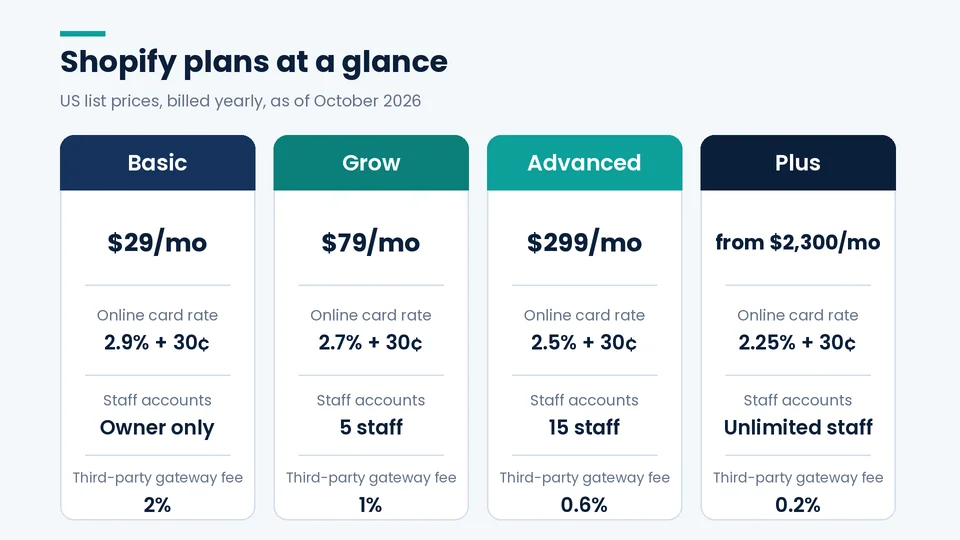
Shopify plans compared side by side
The three standard plans share the same storefront, checkout, themes, and reports. What you pay more for is lower card rates, more staff accounts, better shipping options, and, at the top, deeper customization. Here’s the comparison as listed on Shopify’s pricing page in October 2026.
| Basic | Grow | Advanced | Shopify Plus | |
|---|---|---|---|---|
| Price, billed yearly | $29/month | $79/month | $299/month | From $2,300/month (3-year term) |
| Price, billed monthly | $39/month | $105/month | $399/month | $2,500/month on a 1-year term |
| Online card rate (Shopify Payments) | 2.9% + 30蔵 | 2.7% + 30蔵 | 2.5% + 30蔵 | 2.25% + 30蔵 |
| In-person card rate | 2.6% + 10蔵 | 2.5% + 10蔵 | 2.4% + 10蔵 | 2.3% + 10蔵 |
| Third-party gateway fee | 2% | 1% | 0.6% | 0.2% |
| Additional staff accounts | None | 5 | 15 | Unlimited |
| Inventory locations | 10 | 10 | 10 | 200 |
| Checkout customization | Limited | Limited | Limited | Full |
A few things are the same on every paid plan: unlimited products, unlimited bandwidth, a free SSL certificate, abandoned checkout recovery, discount codes, Shopify’s fraud analysis when you use Shopify Payments, and up to three B2B catalogs on Basic through Advanced. If a comparison site tells you a higher plan adds products or hosting, it’s out of date.
Basic: the right start for most new stores
Basic is the plan for a new store run by one person. You get the full online store, the blog, all of Shopify’s reports including custom reports, and the international selling tools for Shopify Markets. For $29 a month on yearly billing, it covers everything you need to launch and take orders.
Its limits are specific. Shopify’s Basic plan page says the plan doesn’t support adding staff accounts, so only the owner logs in. It can’t use third-party carrier-calculated shipping, so you can’t show live UPS or FedEx rates at checkout. Custom apps built on Shopify’s APIs get limited data access. You also pay the highest card rate of the three standard plans, plus a 2% fee on any order processed through a gateway other than Shopify Payments.
None of that matters much in the first months. It starts to matter when you hire help or when card volume climbs.
Grow: the plan for a small team
Grow adds five staff accounts, drops the online card rate to 2.7% + 30蔵, and halves the third-party gateway fee to 1%. Shopify’s plan guide describes it as the plan for “growing businesses with consistent sales that need more features, such as advanced reporting or additional staff accounts.”
In practice, the staff accounts are what move most stores up. The moment a second person needs to fulfill orders, edit products, or answer customers from the admin, Basic no longer works without sharing one login, which you shouldn’t do. Grow also gives custom apps full data access, and third-party calculated shipping rates are available as a paid add-on.
Advanced: lower rates and control by market
Advanced costs $299 a month on yearly billing. It brings the online card rate down to 2.5% + 30蔵, the gateway fee to 0.6%, and staff accounts up to 15. Live third-party shipping rates are included rather than added on.
The feature that matters most to international sellers is the ability to tailor the buying experience for each market. Shopify’s Advanced plan page says you can customize your theme, checkout, and customer accounts pages for each market. Advanced also includes enhanced 24/7 chat support and, per the pricing page, up to 2x API rate limits on select APIs, which helps stores with heavy ERP or inventory integrations.
Shopify recommends Advanced for “high-volume businesses that need the lowest transaction fees, or businesses migrating from another platform.”
Shopify Plus: when the standard plans run out
Shopify Plus starts at $2,300 a month on a three-year term or $2,500 a month on a one-year term, according to Shopify’s Plus pricing page. More complex, higher-volume businesses move to a variable platform fee based on revenue. The card rate drops to 2.25% + 30蔵, and if you use an outside processor as your main gateway, Shopify charges 0.20% per transaction.
What you’re really paying for is capability the other plans don’t have:
- Full checkout customization, instead of the limited options on Basic through Advanced.
- Unlimited B2B catalogs and up to 200 inventory locations.
- Expansion stores. Your main store and nine expansion stores are included; each additional store costs $300 a month or a revenue share.
- Unlimited staff accounts and priority support.
- Custom apps built with Shopify Functions, which change discount, shipping, and payment logic. Shopify’s developer docs limit custom apps that contain Function APIs to Plus stores.
If you’re deciding between the top two tiers, our comparison of Shopify Advanced vs. Shopify Plus goes feature by feature.
Retired and specialty plans: Starter, Lite, Retail, and Agentic
You’ll still see older plans in search results and on other blogs. Here’s where each stands in October 2026, according to Shopify’s Help Center:
- Starter. “The Starter plan isn’t available to new stores.” Existing Starter stores can keep it, but if they change plans they can’t switch back.
- Lite. Also closed to new stores. It never included an online store, only the Buy Button and point of sale.
- Retail. Closed to new stores. It paired a simple Spotlight-theme store with POS features.
- Agentic. A newer plan with no monthly subscription fee. Your products sell through AI channels, and you pay payment fees on those orders, but you can’t publish an online store or take orders through your own checkout until you move to a paid plan.
For physical retail on a current plan, the add-on to look at is POS Pro, at $89 a month per location on Basic, Grow, and Advanced. Plus includes 20 POS Pro locations.
The break-even math for upgrading
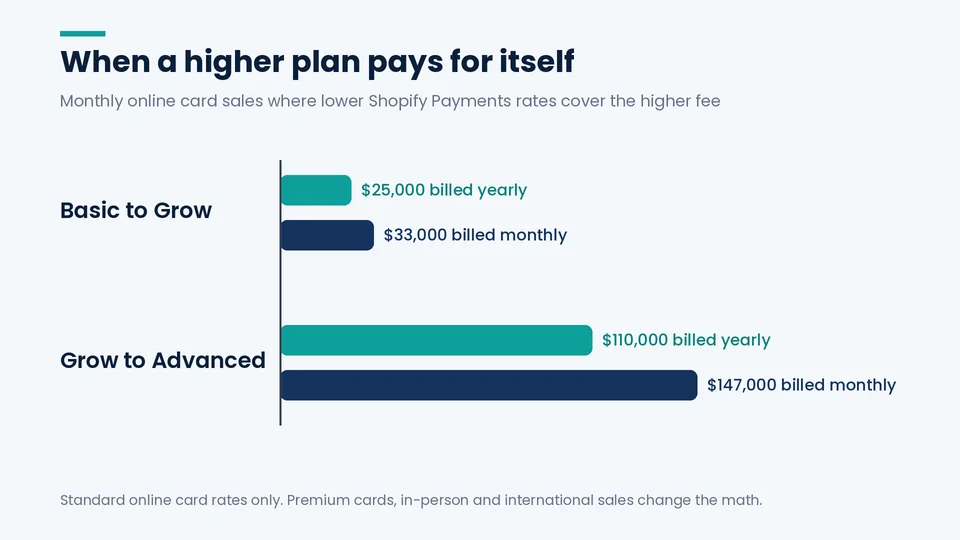
The break-even point is the monthly sales volume where the lower card rate on a higher plan saves as much as the plan costs extra. To find it, divide the difference in plan price by the difference in card rate. Grow beats Basic at about $25,000 a month in online card sales on yearly billing.
Here’s the arithmetic on Shopify’s October 2026 US rates, using online standard card rates through Shopify Payments:
| Upgrade | Extra cost per month | Rate saved | Break-even, billed yearly | Break-even, billed monthly |
|---|---|---|---|---|
| Basic to Grow | $50 yearly / $66 monthly | 0.2 points | About $25,000 a month | About $33,000 a month |
| Grow to Advanced | $220 yearly / $294 monthly | 0.2 points | About $110,000 a month | About $147,000 a month |
If you use a third-party gateway instead of Shopify Payments, the gap in Shopify’s extra fee is wider, so upgrades pay off sooner. Moving from Basic (2%) to Grow (1%) saves one full point, which covers the $50 yearly-billing difference at about $5,000 a month in sales. Moving from Grow (1%) to Advanced (0.6%) breaks even at about $55,000 a month.
Two cautions. First, Shopify’s Help Center publishes its own break-even table, and some of its figures don’t match the arithmetic on today’s pricing page (it lists $200,000 a year for Basic to Grow in the US with Shopify Payments, where current rates work out closer to $300,000). Run the numbers on the rates you actually see. Second, your card mix moves the line. Premium cards, international cards (an extra 1%), and in-person sales at different rates all change the result.
Most stores upgrade for staff or features well before the fee math alone would justify it, and that’s fine. Just know which reason you’re paying for.
Costs that sit outside the plan fee
The plan price is rarely the biggest line on a Shopify bill. Budget for these too:
- Card processing. At 2.9% + 30蔵, a store doing $20,000 a month online pays several hundred dollars in card fees on Basic, more than the plan itself. Our guide to the Shopify merchant account and Shopify Payments breaks down how those fees work.
- Apps and theme. Paid apps bill separately on their own cycle, and premium themes are a one-time purchase.
- Gift cards and store credit. For stores created on or after May 12, 2025, Shopify charges third-party transaction fees on the portion of an order paid with gift cards or store credit.
- Marketplace orders. The first 50 synced marketplace orders a month are free; after that, Shopify charges 1% up to $99 a month.
- POS Pro, at $89 a month per location, if you sell in a store.
We cover more of these trade-offs in our honest look at Shopify’s disadvantages.
Choosing a plan: a five-question check
When PROSeCommerce reviews a client’s plan, two questions usually settle it before any feature comparison: who needs admin access, and how much card volume runs through the store. Here’s the full check we use:
- Does anyone besides the owner need to log in? If yes, Basic is out. Start at Grow.
- What’s your monthly online card volume? Compare it with the break-even table above.
- Will you use Shopify Payments? If not, the third-party fee becomes a large cost and pushes you toward a higher plan.
- Do you need live carrier rates or a different storefront per market? Live rates need Grow with the add-on or Advanced; per-market themes and checkouts need Advanced.
- Do you need full checkout customization, large-scale B2B, or several stores? That’s Shopify Plus territory.
If you’re coming from another platform, factor in the move itself. Our WooCommerce vs. Shopify comparison and our Magento to Shopify migration checklist cover what changes besides the subscription.
Switching plans later
You aren’t locked in on the standard plans. Shopify’s pricing FAQ says you can change or cancel your subscription at any time, except that 1- and 3-year Plus terms run until the commitment expires. A few billing details are worth knowing before you switch:
- Yearly billing charges the full year upfront in exchange for the lower monthly rate.
- Subscription charges are generally non-refundable under section 5.10 of Shopify’s Terms of Service.
- Upgrading during a free trial doesn’t change the trial’s length; charges start when the trial ends.
- If you need to stop selling for a while, you can pause the store at a reduced monthly rate instead of closing it.
Frequently asked questions about Shopify plans
Which Shopify plan is best for a small business?
Does Shopify have a free plan?
Can I still sign up for the Shopify Starter plan?
How much does Shopify cost per month in 2026?
Is the Shopify Grow plan worth it over Basic?
Can I change my Shopify plan at any time?
Picking a plan you won’t outgrow next month
Start with the cheapest plan that covers your team and your must-have features, then let the break-even math tell you when to move up. Recheck the numbers a couple of times a year, because Shopify updates its rates and plan features over time.
If you’d like a second opinion on plan choice, or help setting up a store so the upgrade path stays simple, PROSeCommerce’s Shopify development team can review your setup and costs with you.