

How Shopify Plus and Magento compare in 2026
Shopify Plus vs Magento is a choice between a managed platform and an owned one. Shopify Plus runs the infrastructure, checkout, and upgrades for a monthly fee. Magento, whether the free Open Source edition or the licensed Adobe Commerce, gives you deep control of code and data, and with it the hosting, patching, and upgrade work.
For most direct-to-consumer brands and a growing share of B2B sellers, Shopify Plus now covers the requirements that used to point to Magento. Magento still earns its place where business logic is genuinely unusual, where many storefronts run from one catalog, or where a business has already invested in an Adobe stack and a team that knows it. At PROSeCommerce, part of PROS Global, a San Diego Shopify and Magento agency, we work on both platforms, so this guide is about fit rather than a sales pitch. All vendor facts are from Shopify’s and Adobe’s own pages as of October 2026.
Three products that all get called “Magento”
“Magento” now refers to three different things, and the comparison changes depending on which one you mean:
- Magento Open Source is the free, self-hosted edition. Its code is published on GitHub under the Open Software License 3.0. You pay nothing for the software and everything for hosting, development, security, and support.
- Adobe Commerce is the licensed edition, built on the same core with extra features such as the B2B suite. It runs on premises or on Adobe Commerce on Cloud, a dedicated cloud setup where Adobe provides the infrastructure and you still own upgrades and dependencies.
- Adobe Commerce as a Cloud Service is Adobe’s newer software-as-a-service option. Adobe’s overview describes a headless storefront powered by Edge Delivery Services, and notes that it doesn’t support Luma storefronts.
Shopify Plus is a single product: the top tier of Shopify, on the same hosted platform as every other Shopify plan.
Shopify Plus vs Magento at a glance
| Factor | Shopify Plus | Magento Open Source | Adobe Commerce |
|---|---|---|---|
| Software cost | From $2,300 a month (three-year term) | Free license | Quoted by Adobe sales |
| Hosting | Included | You arrange and pay | Adobe cloud options or self-managed |
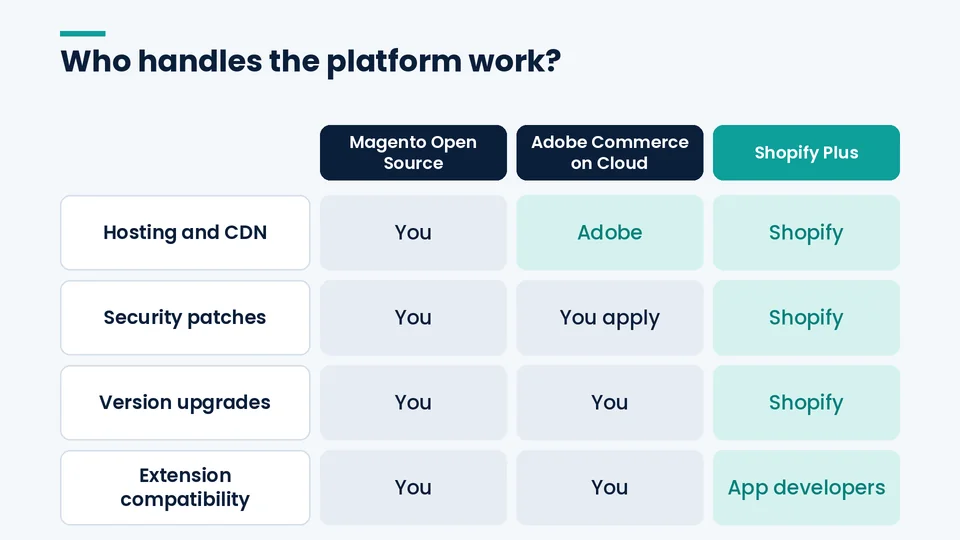
| Upgrades and patches | Applied by Shopify | Your team | Your team, except on the SaaS option |
| Code access | Themes, apps, Shopify Functions | Full source code | Full source code on self-managed and Cloud (PaaS) installs |
| Native B2B | Yes, all plans; extras on Plus | Not included | B2B extension |
| Multiple storefronts | Main store plus up to 9 expansion stores | Websites, stores, and store views in one install | Same as Open Source |
| Checkout | Shopify Checkout, customizable on Plus | Fully customizable | Fully customizable |
Licensing and total cost of ownership
Shopify Plus has a published starting price; Adobe Commerce doesn’t. Magento Open Source has no license fee at all. That makes a fair comparison a total-cost exercise covering license, hosting, development, upgrades, apps or extensions, and payments over three years, not a comparison of sticker prices.
Shopify Plus. As of October 2026, the Shopify Plus pricing page lists $2,300 a month on a three-year term or $2,500 on a one-year term for standard setups. Shopify says more complex, higher-volume businesses move to a variable platform fee based on revenue and business model. Using a third-party payment gateway adds 0.20% per transaction; with Shopify Payments, US online standard card rates on Plus are 2.25% + 30¢. Stores beyond the nine included expansion stores cost an extra $300 a month each (or a revenue share), and each contract covers one brand.
Adobe Commerce. Adobe’s pricing page lists Adobe Commerce as a Cloud Service, Adobe Commerce on Cloud, and Adobe Commerce Optimizer, each with a “Get pricing” request rather than a list price. Treat any figure you see on third-party sites as an estimate until Adobe quotes you.
Magento Open Source. The license is free, but you fund hosting, a CDN, search infrastructure, security monitoring, PCI scope, extensions, and a developer or agency who knows Magento.
| Cost line | Shopify Plus | Magento Open Source or Adobe Commerce |
|---|---|---|
| Platform license | Published monthly fee or variable fee | Free (Open Source) or Adobe quote |
| Hosting and CDN | Included | Separate, unless on an Adobe cloud option |
| Version upgrades | Included | Project work every release line |
| Security patching | Included | Your team applies patches |
| Apps or extensions | App subscriptions | Extension licenses plus integration work |
| Payments | Card rates, or 0.20% extra on outside gateways | Gateway rates only |
When PROSeCommerce scopes a replatforming decision, we give upgrade work its own line, because it’s the cost that differs most between the two platforms. On Shopify there’s no upgrade project to budget. On Magento it recurs with every release line, as the next section shows.
Hosting, upgrades, and the support calendar
Magento stores live on a support calendar. Adobe gives each Adobe Commerce release three years of standard support from its general availability date, and stores on unsupported versions stop getting security fixes. Shopify Plus has no version numbers to track; Shopify updates the platform for every store.
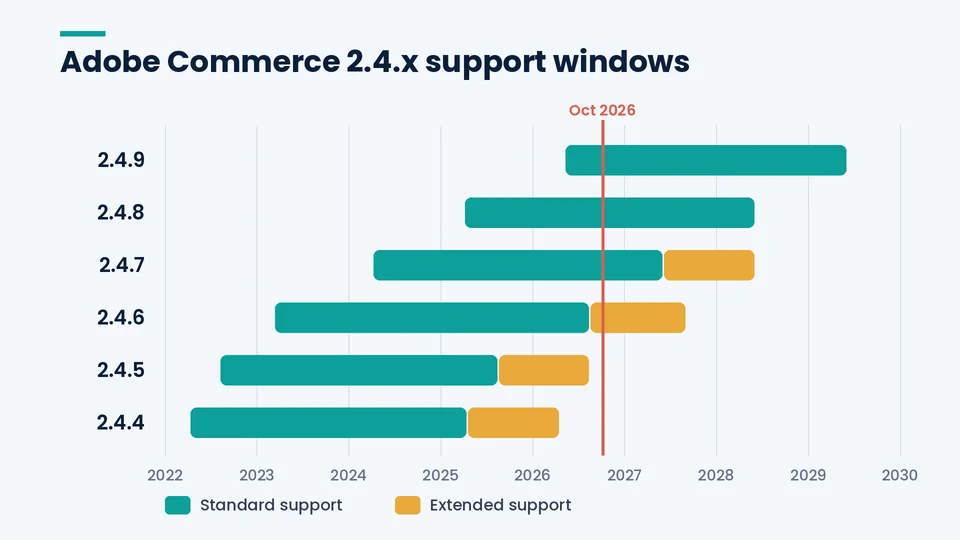
Adobe’s lifecycle policy, last updated September 18, 2026, lists these dates:
| Release | General availability | End of standard support | End of extended support |
|---|---|---|---|
| 2.4.9 | May 12, 2026 | May 31, 2029 | To be announced |
| 2.4.8 | April 8, 2025 | May 31, 2028 | To be announced |
| 2.4.7 | April 9, 2024 | May 31, 2027 | May 31, 2028 |
| 2.4.6 | March 14, 2023 | August 11, 2026 | August 31, 2027 |
| 2.4.5 | August 9, 2022 | August 12, 2025 | August 11, 2026 |
| 2.4.4 | April 12, 2022 | April 12, 2025 | April 14, 2026 |
A few details in the same policy matter for planning:
- Releases 2.4.4, 2.4.5, and 2.4.6 get a one-time, security-only transitional period ending May 31, 2027 (2.4.4 and 2.4.5) or May 31, 2028 (2.4.6). Adobe describes it as migration time, not a support tier.
- Starting June 1, 2027, Adobe says it will no longer maintain Adobe Commerce on Cloud environments running unsupported versions, which can include suspending traffic to the store.
- PHP 8.1 reached end of life on December 31, 2025, and PHP 8.2 reaches it on December 31, 2026, which Adobe flags as a PCI compliance risk for older release lines.
- On Adobe Commerce on Cloud, merchants remain responsible for keeping third-party dependencies such as MariaDB, OpenSearch, and Redis on supported versions.
None of that makes Magento a bad platform. It means a Magento budget needs a standing line for upgrades, and a store several releases behind should price the upgrade and a platform move side by side.
Customization: open code vs extension points
Magento’s biggest strength is that you can change anything. You own the database, the business logic, and the checkout, so custom pricing engines, configurators, and unusual order flows can be built into the platform itself. The trade-off is that every customization has to survive the next upgrade.
Shopify Plus works through defined extension points instead:
- Shopify Functions let developers replace or extend back-end logic for discounts, shipping, payments, and validation. According to Shopify’s Functions documentation, any plan can use public App Store apps that contain functions, but only Plus stores can use custom apps built with Function APIs.
- Checkout customization on Plus includes the Checkout Branding API and checkout extensions, per the Shopify Plus plan page.
- Shopify Scripts are gone. Shopify’s Help Center confirms that, as of June 30, 2026, Scripts are deprecated and any published scripts have been deactivated, so discount and shipping logic now needs Functions or an app.
In practice, most custom logic that merchants ask for maps to a Function, an app, or an integration. The requirements that don’t map cleanly, such as deeply nested pricing rules or order flows that change core checkout behavior, are where Magento keeps its edge.
B2B commerce on each platform
Both platforms sell B2B well; they differ in depth and in how much of it is built in.
On Shopify, B2B is available on every plan, including companies, catalogs, net payment terms, and self-serve ordering. Plus adds unlimited catalogs, catalogs assigned directly to specific companies and locations, and deposits, partial payments, and payment requests per fulfillment.
Adobe Commerce’s B2B extension goes further on complex buying: company accounts with hierarchies, shared catalogs for custom price levels, negotiable quotes, purchase order approvals, requisition lists, quick order by SKU, and payment on account. The B2B suite is part of Adobe Commerce, not Magento Open Source.
If your B2B model is wholesale pricing, net terms, and reorders, Shopify Plus usually covers it. If buyers negotiate quotes line by line and orders need multi-step approval inside the buyer’s company, Adobe Commerce fits more naturally.
Multiple storefronts and international selling
Every Magento installation has a hierarchy of websites, stores, and store views, as Adobe’s scope documentation explains. One install can run several websites on different domains, with stores sharing a catalog and store views for languages. For a business running many brands or regional sites from one catalog and one admin, that’s a real advantage.
Shopify Plus handles international selling in two ways. Shopify Markets manages currencies, languages, and local domains inside one store, and Plus includes up to nine expansion stores for separate regions or physical locations. Expansion stores are separate stores, each live one needs its own theme license according to Shopify’s Help Center, and a Shopify Plus contract covers a single brand, so multi-brand companies need a separate contract per brand.
Performance and scaling
Shopify runs and scales the infrastructure for every Plus store. On its Plus pricing page, Shopify says checkout is load-tested at more than 10,000 checkouts per minute. That’s Shopify’s own claim, but the practical point stands: peak-day capacity isn’t your team’s problem.
On Magento, performance depends on your hosting, caching, search setup, and code quality. A well-built Magento store on good infrastructure is fast, and a neglected one isn’t. Adobe’s Cloud Service option shifts more of this to Adobe, but on Open Source or self-managed Adobe Commerce, capacity planning for peak traffic sits with you. On Shopify, storefront speed still depends on theme and app choices, which our guide on how to speed up your Shopify store covers.
When each platform is the better fit
Signs Magento is still the right call
- Your pricing, configuration, or order logic can’t be expressed through Shopify Functions, apps, or integrations without heavy compromise.
- You run several brands or regional sites from one catalog and want one admin across them.
- Your B2B buyers depend on negotiable quotes, approval chains, and company hierarchies.
- You have, or will fund, a team that can own hosting, patches, and upgrades for the long term.
- You’re deeply invested in Adobe Experience Cloud products and want commerce in the same stack.
Signs Shopify Plus is the better move
- Your Magento release is near or past the end of standard support, and the upgrade quote is large.
- Your team spends more time maintaining the platform than improving the store.
- Your customizations mostly exist to fill gaps that Shopify now covers natively or through Functions.
- You want predictable platform costs and no infrastructure on your side.
- Your B2B needs are wholesale pricing, net terms, and reorders rather than quote negotiation.
If you’re also weighing plans within Shopify, our comparison of Shopify Advanced vs. Shopify Plus explains which features actually require Plus, and our list of Shopify’s disadvantages covers the limits you’ll work within.
Planning a move from Magento to Shopify Plus
A Magento to Shopify Plus move is mostly a data, URL, and integration project. Products, customers, and order history can be migrated, but extensions, custom modules, and the theme don’t carry over and have to be replaced with apps, Functions, or custom work. The biggest SEO risk is URLs: Magento’s category and .html URLs need a complete 301 redirect map to Shopify’s /products/ and /collections/ paths.
Our Magento to Shopify migration checklist walks through the audit, data mapping, redirects, and launch-day steps in order.
Frequently asked questions about Shopify Plus and Magento
Is Magento better than Shopify Plus?
How much does Adobe Commerce cost compared with Shopify Plus?
Is Magento Open Source really free?
Can Shopify Plus handle complex B2B?
What happens when a Magento version reaches end of support?
Can I move from Magento to Shopify Plus without losing SEO?
Making the platform decision
Shopify Plus and Magento are both serious platforms. The decision comes down to how much you want to own: Magento rewards teams that need control and can maintain it, and Shopify Plus rewards teams that would rather put that effort into merchandising and growth.
If you’re on Magento and weighing an upgrade against a move, PROSeCommerce can review your extensions, integrations, and URL structure and tell you what each path involves. Our Shopify migration services cover Magento to Shopify Plus moves from audit to launch, and we’ll say so if staying on Magento is the better option.