
How does an online marketplace work?
An online marketplace is a website or app where many independent sellers list products and buyers purchase them in one place. The marketplace operator runs the platform, brings in shoppers, handles search and often processes payments, and in return charges sellers fees. Sellers supply the products, set most prices and fulfill orders themselves or through the marketplace’s logistics service. Buyers get choice and comparison in one checkout.
Marketplaces have grown from simple listing boards into large platforms with advertising, fulfillment, payments and seller rules. This guide covers how marketplaces work, the main business models, how they make money, how they compare with running your own store, the seller-verification rules that now apply in the United States, and how to decide whether selling on a marketplace fits your brand. PROSeCommerce, part of PROS Global in San Diego, helps brands sell through their own stores and through marketplaces, and the figures below were checked as of October 2026.
How online marketplaces evolved
Early online marketplaces were mostly listing sites: sellers posted items, buyers contacted them and the two sides arranged payment and delivery themselves. Over time, marketplace operators took on more of the transaction. Today a large marketplace typically handles:
- Discovery. Search, categories, recommendations and reviews that help buyers find products.
- Payments. Checkout and payment processing, with payouts to sellers.
- Trust. Ratings, buyer protection policies, returns rules and seller verification.
- Logistics. Optional warehousing, packing and shipping services for sellers.
- Advertising. Paid placements that let sellers promote listings inside the marketplace.
That shift turned marketplaces from simple directories into full sales channels. For a seller, it means less work to reach buyers, but also more rules and more fees.
The scale is large. According to the U.S. Census Bureau’s quarterly retail e-commerce report, U.S. retail e-commerce sales were an estimated $340.2 billion in the latest quarter reported as of October 2026, adjusted for seasonal variation. That was 17.1% of total retail sales and 12.2% more than the same quarter a year earlier. Those figures cover all online retail, not marketplaces alone, but they show how much buying has moved online.
Types of online marketplaces
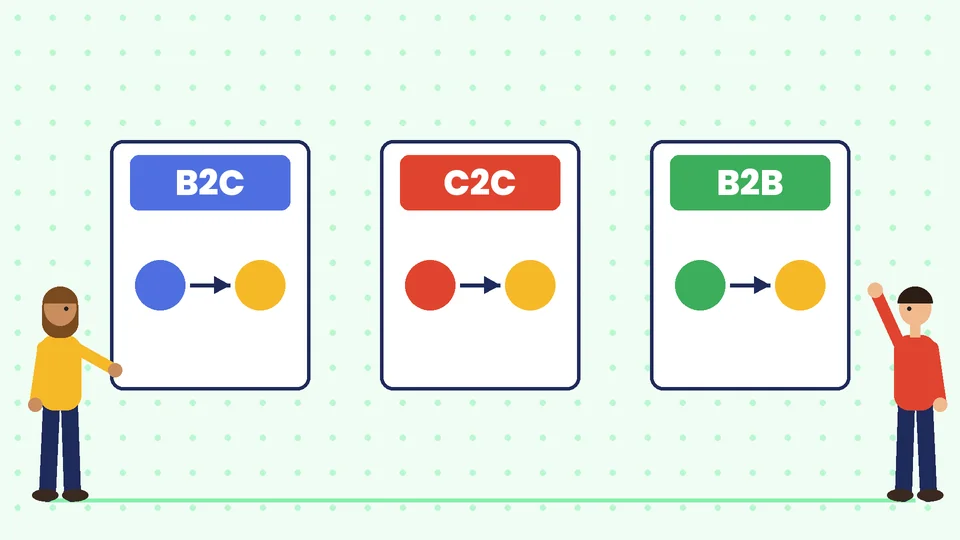
Marketplaces are usually grouped by who sells to whom and what they sell.
| Model | Who trades | Typical examples of what is sold |
|---|---|---|
| B2C (business to consumer) | Brands and retailers sell to shoppers | Consumer goods, electronics, apparel |
| C2C (consumer to consumer) | Individuals sell to individuals | Used items, collectibles, handmade goods |
| B2B (business to business) | Companies sell to companies | Wholesale supplies, parts, equipment |
| Vertical | One category or niche | Fashion, home goods, crafts, auto parts |
| Horizontal | Many categories | General merchandise across departments |
| Services | Providers offer time or skills | Freelance work, local services, rentals |
Many large platforms mix several models. A general marketplace may host big brands, small businesses and individual sellers in the same search results.
The model matters for sellers. On a B2C or horizontal marketplace you compete with established brands for the same search terms, so listing quality and price matter most. On a vertical marketplace the audience is smaller but more focused, and buyers often expect specialist knowledge. B2B marketplaces usually involve larger orders, account terms and repeat buying, so reliability and accurate product data count for more than eye-catching listings.
Marketplace fees and revenue streams
Most marketplaces earn revenue from some combination of:
- Subscription or plan fees. A monthly fee for a seller account.
- Per-item or listing fees. A charge for each item listed or sold.
- Referral or commission fees. A percentage of each sale, often varying by category.
- Fulfillment fees. Charges for storing, packing and shipping orders.
- Advertising. Sponsored product and brand placements.
- Payment processing. Fees on the transaction itself, on some platforms.
Amazon is a useful example because its pricing page spells out the structure. According to Amazon’s selling fees page, the Individual plan costs $0.99 per item sold, and the Professional plan costs $39.99 per month plus selling fees. Referral fees are charged on each sale and vary by product category, and Fulfillment by Amazon has its own costs. Fees change, so check the current page before you build a pricing model. Our guides to Amazon Vendor Central and choosing Amazon advertising go deeper on that platform.
Marketplace vs. your own online store
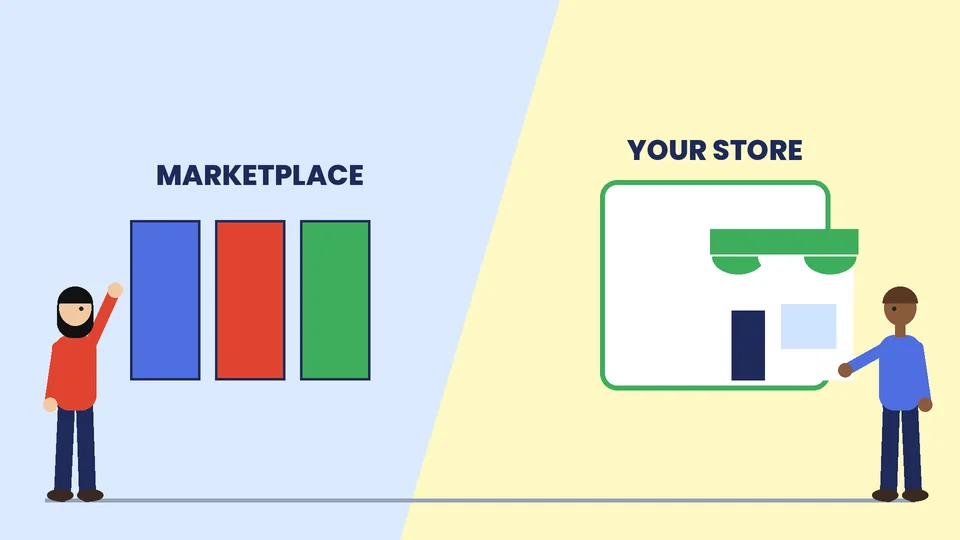
Selling on a marketplace and selling through your own store solve different problems. Many brands do both.
| Factor | Marketplace | Your own store |
|---|---|---|
| Traffic | Built-in shopper base | You must drive your own visitors |
| Setup | Fast; listing tools are provided | Takes design, development and setup work |
| Fees | Plan, referral, fulfillment and ad fees | Platform, hosting, apps and payment fees |
| Customer data | Limited; the marketplace owns the relationship | Full access to customer and order data |
| Branding | Constrained by the marketplace’s layout | Full control of design and content |
| Rules | Marketplace policies can change at any time | You set your own policies, within the law |
| Competition | Competitors appear next to your listings | Your site shows only your products |
A marketplace can bring sales quickly, especially for products people already search for by name or type. Your own store builds a direct relationship with customers, which supports repeat purchases, email marketing and brand loyalty. Our article on the benefits of direct-to-consumer marketing explains that side of the decision, and our introduction to ecommerce covers the basics of selling online.
Seller verification: the INFORM Consumers Act
Marketplaces in the United States now have legal duties to verify certain sellers. The INFORM Consumers Act, codified at 15 U.S.C. § 45f, took effect 180 days after December 29, 2022, which was June 27, 2023. In general terms:
- A high-volume third party seller is a seller that, in any continuous 12-month period during the previous 24 months, has made 200 or more separate sales of new or unused consumer products and at least $5,000 in gross revenue on that marketplace.
- The marketplace must collect the seller’s bank account information, tax identification number and contact information within 10 days of the seller qualifying, and verify it within 10 days of collection.
- The marketplace must remind these sellers at least once a year to keep their information current and have them certify it.
- For high-volume sellers with $20,000 or more in annual gross revenue on the marketplace, certain identifying details, such as name and contact information, must be disclosed to consumers on the product listing or in the order confirmation, with some exceptions.
- Violations by marketplaces are enforced by the Federal Trade Commission and state attorneys general.
For sellers, this means you should expect identity and tax checks once you pass the thresholds, and you should keep your details up to date. This summary is general information, not legal advice; read the statute and talk to an attorney about your situation.
How to choose a marketplace to sell on
Before you list products, answer these questions:
- Where do your customers already shop? Look at where your category sells and where competitors appear.
- What will each sale really cost? Add plan fees, referral fees, fulfillment, advertising and returns, then compare with your margins.
- Can you meet the marketplace’s rules? Check shipping speed, returns, product category restrictions and listing requirements.
- How will you handle inventory? Decide whether you will fulfill orders yourself or use the marketplace’s service, and how stock will sync with your own store.
- What is your brand plan? Decide which products you sell on marketplaces and which you keep for your own site.
- How will you measure success? Track profit per order, not just revenue.
Marketplaces can also be connected to your main store. Our guide to Shopify Plus and Walmart integration explains how one store can feed listings to another channel.
Tips for selling successfully on a marketplace
- Write complete listings. Fill in every attribute, use clear titles and add accurate dimensions, materials and compatibility details.
- Use good images. Show the product from several angles, in use and at scale, following each marketplace’s image rules.
- Price with every fee in mind. A low price that ignores fulfillment and ad costs can lose money on each order.
- Ship fast and communicate. Late shipments and slow replies hurt seller ratings.
- Manage reviews honestly. Ask for feedback the way the marketplace allows, and never offer rewards for positive reviews.
- Protect your brand. Register your brand where the marketplace offers it and watch for unauthorized sellers.
- Keep your own store. Use marketplace sales to build awareness while you grow direct customers.
Common challenges for marketplace sellers
Marketplaces make it easy to start, but sellers often run into the same problems:
- Thin margins. Referral, fulfillment and advertising fees add up, and price competition can push margins lower.
- Rule changes. Marketplaces update fees, policies and search ranking factors, and a change can affect sales overnight.
- Account health. Late shipments, cancellations or policy complaints can lead to warnings or suspension.
- Competing sellers. Other sellers can list the same or similar products right next to yours, sometimes at lower prices.
- Limited customer access. You usually cannot market directly to marketplace buyers after the sale.
- Dependence on one channel. If most revenue comes from a single marketplace, any problem there affects the whole business.
Planning for these risks early, with a healthy margin, more than one sales channel and clean operations, makes marketplace selling more stable.
Frequently asked questions
What is an online marketplace?
How is a marketplace different from an online store?
How do online marketplaces make money?
How much does it cost to sell on Amazon?
What is the INFORM Consumers Act?
Should I sell on a marketplace or build my own store?
Plan your marketplace strategy
Online marketplaces have grown from listing boards into full sales channels with payments, logistics, advertising and seller verification. They can add sales quickly, but they come with fees, rules and less control over your brand. Work out your true cost per order, choose marketplaces where your customers already shop and keep building your own store alongside them. If you want help planning your marketplace and direct sales strategy, contact PROSeCommerce.