
What should a B2B ecommerce business outsource?
Most B2B ecommerce businesses do well to outsource the specialist, variable or round-the-clock work: warehousing and fulfillment, store development and integrations, ongoing site maintenance, paid media and SEO, and overflow customer support. Keep in-house the work that defines your relationship with buyers: pricing strategy, key account management, product knowledge and final decisions on terms and credit. The right split depends on your order volume, how complex your catalog and pricing are, and whether you have people who can manage outside partners well.
This guide covers what B2B sellers usually outsource, what they should keep, how to compare costs, how to choose and contract partners, and how to keep control once the work is out of house. At PROSeCommerce, part of PROS Global in San Diego, we work alongside in-house teams on B2B store builds and integrations, so the advice below reflects how these partnerships tend to work in practice. Platform and regulatory details were checked against official sources as of November 2026.
Why B2B ecommerce is harder to run alone
B2B online selling has more moving parts than a typical consumer store. A single buyer account may need several users with different permissions. Prices often vary by customer, volume or contract. Many orders are paid on net terms or by purchase order instead of by card at checkout. Orders often flow into an ERP, a warehouse system and an accounting package, and a mistake in any of those hand-offs reaches the customer as a wrong price, a late delivery or an incorrect invoice.
Platforms now handle much of this natively. Shopify, for example, says its B2B features are available on the Basic, Grow, Advanced and Shopify Plus plans (but not Starter or Retail) and let you set company accounts, catalogs and pricing, payment terms and shipping methods per customer, according to the Shopify B2B help center as of November 2026. What the platform can’t do is design your setup, connect it to your other systems, or run the store day to day. That’s where outsourcing usually starts. Our guide to Shopify Plus for B2B merchants compares the B2B features by plan.
The B2B functions most worth outsourcing
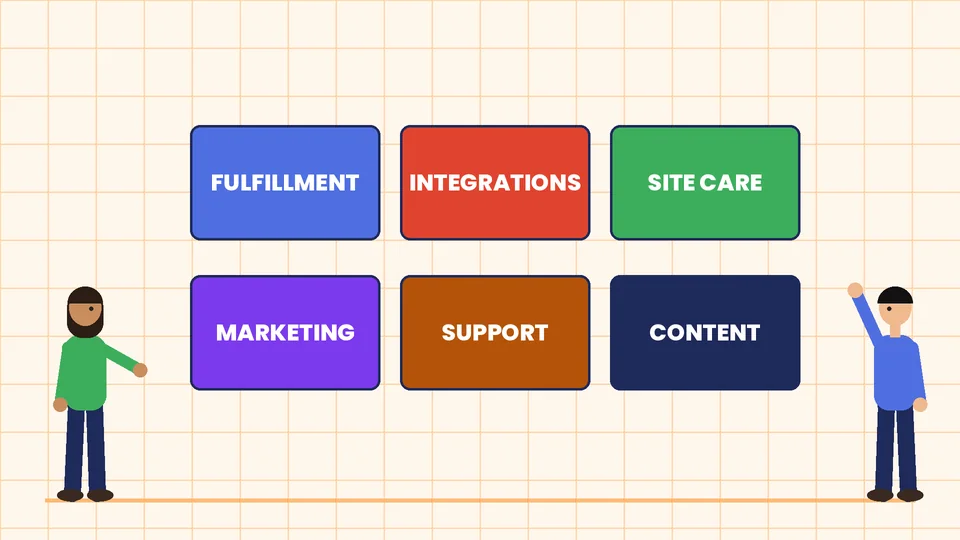
These are the functions B2B sellers most often hand to specialists, with the main reason for each:
| Function | Why companies outsource it | Keep an eye on |
|---|---|---|
| Warehousing and fulfillment (3PL) | Space, staff and carrier rates scale with volume | Pallet and freight handling, order accuracy, cut-off times |
| Store development and theme work | Specialist skills you need in bursts | Code ownership, documentation |
| ERP, PIM and accounting integrations | Hard to build well without experience | Error handling, sync frequency, who fixes failures |
| Site maintenance and app updates | Regular, routine and easy to forget | Response times, testing before changes go live |
| SEO, paid media and email | Tools and expertise are expensive to keep in-house | Reporting tied to revenue, not just traffic |
| Customer support overflow | Covers hours and peaks without hiring | Product knowledge, escalation to your team |
| Content and product data entry | High volume, repetitive work | Accuracy of specs, units and pricing |
Fulfillment and logistics
B2B orders can mix single cartons with full pallets, need freight quotes, and come with buyer-specific labeling or routing rules. A third-party logistics provider (3PL) that already handles B2B freight can save you from building those processes yourself. Ask how they handle mixed orders, how they report inventory to your store, and what happens when an order misses a carrier cut-off.
Development and integrations
Integrations are where B2B stores most often break. Prices, stock levels, customer accounts and invoices have to stay in sync between the store and your back-office systems. An experienced integration partner will plan for failures, such as what happens when an ERP update stops syncing overnight. Our Shopify integration guide covers ERP, 3PL and CRM connections in more depth.
Maintenance
App updates, theme changes and platform releases can quietly break checkout rules or pricing for some customers. A maintenance retainer gives you regular checks and a named person to call. Our Shopify website maintenance checklist shows what a good weekly and monthly routine includes.
Marketing and demand generation
B2B buyers research for weeks and often involve several people in a decision. Agencies can run SEO, paid search, LinkedIn and email programs, but they need your input on buyer roles, deal sizes and sales cycles. Read how B2B marketing works before you brief an agency.
What to keep in-house
Outsourcing works best when you keep the decisions that shape your customer relationships:
- Pricing and terms. Partners can configure price lists, but your team should decide them and approve changes.
- Key account relationships. Large buyers expect a named contact who knows their history.
- Product expertise. Specs, compatibility and technical questions need people who know the products.
- Data ownership. Make sure you own the store, the domain, the code you paid for, and all customer and order data.
- Vendor management. Someone inside the business must own each partner relationship, review reports and hold partners to the agreement.
Comparing in-house and outsourced costs
Compare the full cost of each option, not just the invoice:
- In-house cost: salaries, payroll taxes and benefits, recruiting, training, software licenses, management time and cover for holidays and turnover.
- Outsourced cost: retainers or hourly rates, setup fees, minimum commitments, per-order or per-pallet fees, and the internal time needed to manage the partner.
- Switching cost: what it takes to move to another provider or bring the work back in-house, including data exports and knowledge transfer.
- Risk cost: what an outage, a fulfillment error or a security incident would cost you, and who pays under the contract.
Get at least two or three quotes for the same written scope, so you’re comparing like for like.
Contractors, agencies and the IRS
If you hire individual freelancers rather than firms, how you manage them matters. The IRS says the general rule is that someone is an independent contractor if the payer only has the right to control or direct the result of the work, not what will be done and how it will be done. It looks at evidence in three categories: behavioral control, financial control and the type of relationship, as described on its independent contractor or employee page. If you set a freelancer’s hours, tools and methods like an employee’s, get advice before you classify them as a contractor.
This is general information, not legal advice or tax advice.
How to choose an outsourcing partner
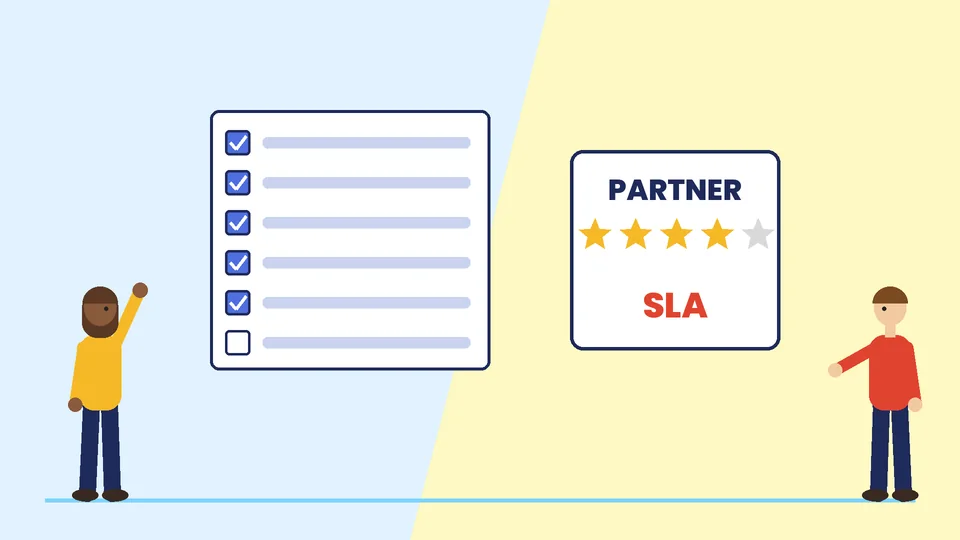
Use the same checklist for every candidate:
- Relevant B2B experience. Ask for examples with customer-specific pricing, net terms or ERP connections, not just consumer stores.
- A written scope. Deliverables, exclusions, response times and how change requests are priced.
- Named people. Who does the work, who manages your account and who covers when they’re away.
- Access and security. Staff accounts with the least access needed, no shared logins, and a way to remove access on the same day the work ends.
- Reporting. Agree the metrics up front, such as order accuracy, on-time shipping, ticket response times or revenue from organic search.
- Ownership and exit. You own the code, content, accounts and data, and the contract spells out how they’re handed back.
- References. Speak to at least one current client with a similar setup.
For store work specifically, our guide to hiring an ecommerce consultant lists the questions to ask before you sign.
Managing outsourced work without losing control
Once a partner is in place, a light but steady routine keeps the work on track:
- Kick-off document. A single page with goals, contacts, systems, access and escalation paths.
- Weekly or fortnightly check-ins while work is active, then monthly once things are stable.
- One shared task list so requests don’t get lost in email.
- A test step before changes reach live buyers, especially for pricing, checkout and integrations.
- A quarterly review of results against the agreed metrics, cost and scope.
Keep ownership of the things that are hard to get back. Your store admin, ERP, domain, analytics and ad accounts should be registered to your company, with the partner added as a user rather than the owner. Ask for documentation of any custom integration or script they build, and store it somewhere your team controls. If the relationship ends, you can then hand the work to another partner or bring it in-house without rebuilding from scratch.
Common outsourcing mistakes in B2B ecommerce
- Outsourcing a process you haven’t defined. If your own team can’t describe how quotes or credit approvals work, a partner can’t automate them.
- Choosing on price alone. The cheapest integration often costs the most once orders start failing.
- Letting partners own accounts. Domains, ad accounts, analytics and app subscriptions should sit in your company’s name.
- No exit plan. Without a handover clause, switching providers can mean rebuilding from scratch.
- Too many partners and no owner. Every vendor needs a named internal owner.
Frequently asked questions
What is B2B ecommerce outsourcing?
Which B2B ecommerce tasks should not be outsourced?
Is it cheaper to outsource B2B ecommerce work?
Can Shopify handle B2B ecommerce?
How do I protect my data when I outsource?
Should I hire freelancers or an agency for B2B ecommerce work?
Build a B2B operation you can scale
Outsourcing lets a B2B ecommerce team spend its time on buyers, pricing and products while specialists run the systems around them. Define each process first, keep ownership of decisions and data, and pick partners with real B2B experience. If you want help building or connecting a B2B store, contact PROSeCommerce.