

What an ecommerce consultant does
An ecommerce consultant is an outside specialist who diagnoses why an online store is not growing, decides what to change, and helps your team carry out the plan. The work usually covers platform choice, conversion, operations, integrations, and search visibility. A good consultant leaves you with clear decisions and a prioritized roadmap, not just a slide deck.
That definition matters because the title is used loosely. Some “consultants” are agencies selling builds, some are freelancers selling hours, and some are software resellers. This guide explains, as of October 2026, what real consulting includes, the benefits worth paying for, typical ways engagements are priced, and how to tell whether you need a consultant at all. It is written for US brands on Shopify, Magento (Adobe Commerce), WooCommerce, or a custom stack, and it reflects how PROSeCommerce, part of PROS Global in San Diego, scopes advisory work before any development starts.
The main benefits of hiring an ecommerce consultant
The core benefit of hiring an ecommerce consultant is speed to a correct decision. A consultant who has seen dozens of stores can spot the real constraint, whether that is checkout friction, catalog data, slow pages, or the wrong platform, in days instead of the months a team might spend guessing.
The benefits merchants tend to value most:
- An outside diagnosis. Internal teams get used to workarounds. A consultant audits analytics, checkout, catalog, and operations without those habits and names the issues plainly.
- Platform and vendor decisions with less risk. Choosing between Shopify, Shopify Plus, Magento, or WooCommerce, or between apps and custom code, is expensive to reverse. A consultant compares options against your requirements rather than a sales quota.
- A prioritized roadmap. Good consulting ranks fixes by impact and effort so the team works on what moves revenue first.
- Specialist skills on demand. You get migration planning, technical SEO, integration architecture, or conversion analysis without hiring full-time roles you only need for a quarter.
- Better briefs for developers and agencies. A clear scope and acceptance criteria reduce change orders and rework once a build starts.
- Knowledge transfer. The best engagements leave your team able to run the new process without the consultant.
None of these benefits come from the title alone. They depend on the consultant’s experience with stores like yours and on how clearly the engagement is defined.
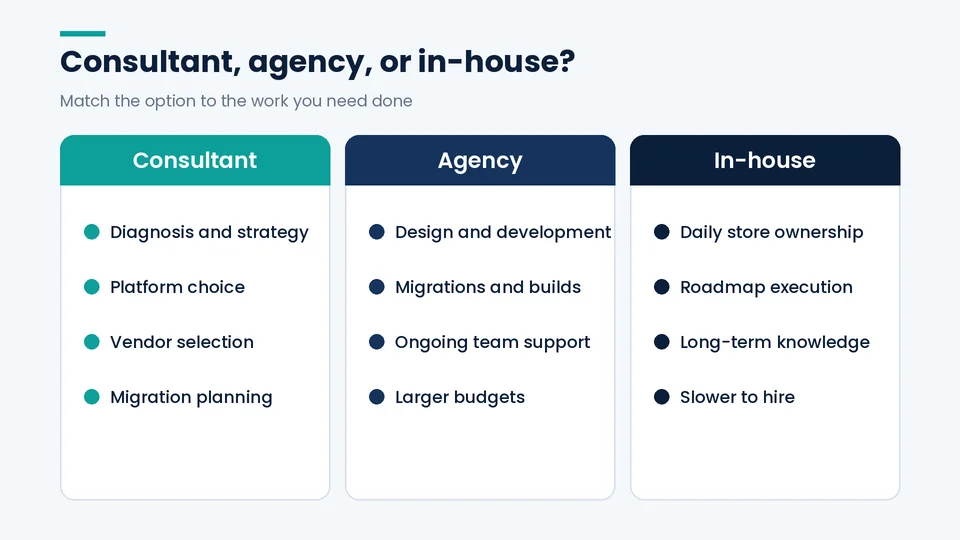
Consultant, agency, or in-house hire
Consultants, agencies, and in-house hires solve different problems, so compare them by the type of work you need rather than by price alone.
| Option | Best for | Watch out for |
|---|---|---|
| Ecommerce consultant | Diagnosis, strategy, platform choice, vendor selection, migration planning | Advice without execution if your team lacks capacity |
| Ecommerce agency | Design, development, migrations, and ongoing builds with a team | Recommendations that favor the services the agency sells |
| In-house hire | Ongoing daily ownership of the store and its roadmap | Narrow experience and a long hiring cycle |
| Freelance specialist | One well-defined task, such as a theme fix or feed setup | Limited coverage if the scope grows |
Many merchants combine them: a consultant sets direction and writes the brief, an agency or developers build it, and an in-house manager owns the result. If you are hiring builders after the strategy phase, our guide on how to choose Shopify developers explains how to evaluate them.
Signs your store needs outside help
You probably need an ecommerce consultant when growth has stalled and the team cannot agree on why, or when a major decision is coming that you have never made before.
Common triggers we see:
- Traffic is steady but conversion keeps sliding. The cause could be page speed, checkout steps, pricing, trust signals, or traffic quality, and guessing wastes ad spend.
- A replatform is on the table. Moving between platforms touches URLs, data, integrations, and SEO. Our Magento to Shopify migration checklist shows how many moving parts there are.
- Operations are breaking. Overselling, slow fulfillment, or manual spreadsheet syncs between the store, ERP, and 3PL usually signal an integration problem.
- Organic search traffic dropped. A consultant can separate technical issues from content and competition. Start with our ecommerce SEO tips if you want a self-check first.
- You are choosing an enterprise plan. Deciding between Shopify Plus and Adobe Commerce is a multi-year commitment. Our comparison of Shopify Plus and Magento covers the main trade-offs.
- The team is too close to the problem. If every meeting ends in opinions instead of data, an outside view resets the conversation.
If none of these apply and your store is growing on plan, you may not need a consultant yet. A periodic audit can be enough.
What a typical engagement looks like
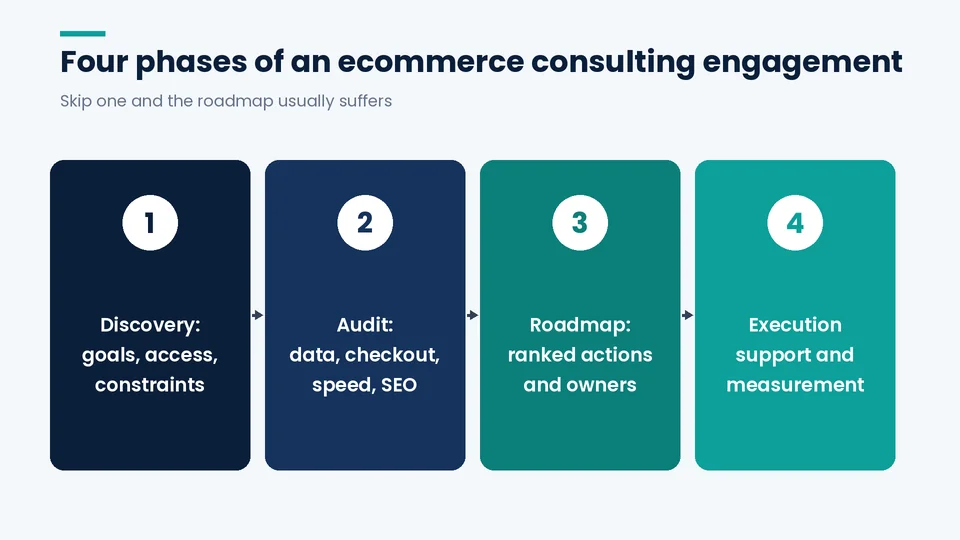
Most ecommerce consulting engagements follow four phases: discovery, audit, roadmap, and support during execution. The names vary, but skipping any of them usually causes trouble later.
Discovery. The consultant interviews owners and key staff, reviews goals and constraints, and gets read access to the store admin, analytics, and Search Console.
Audit. This is the evidence phase: analytics and funnel review, checkout walkthroughs, page speed tests, catalog and data checks, app and integration inventory, and a technical SEO crawl. Findings should cite data, not opinions.
Roadmap. Findings become a ranked list of actions with expected impact, effort, owner, and dependencies. A strong roadmap also says what not to do.
Execution support. The consultant helps write briefs, reviews vendor proposals, answers questions during the build, and checks results against the targets set in the roadmap.
How ecommerce consultants charge
Consultants usually price work in one of three ways, and each fits a different kind of problem.
- Fixed-fee audits or projects. A defined deliverable, such as a platform recommendation or a conversion audit, for a set price. Good when the scope is clear.
- Hourly or day rates. Flexible for advisory calls and reviews, but you need a cap and a clear agenda.
- Monthly retainers. Ongoing strategy and oversight for a set number of hours or meetings each month. Useful during a long migration or growth program.
Rates vary widely by experience, region, and scope, so compare proposals on deliverables and outcomes rather than headline price. Ask every candidate what you will hold in your hands at the end of each phase, who does the work, and how success will be measured. A consultant who cannot answer those three questions clearly is not ready to take your budget.
Questions to ask before you sign
Use these questions in your first calls. They separate experienced consultants from generalists quickly.
- Which platforms have you worked on in the last two years, and at what order volumes? Look for experience with stores similar to yours.
- Can you show a past audit or roadmap with client details removed? The quality of the deliverable tells you more than a pitch.
- Do you sell development, apps, or hosting? That is fine, but you need to know where recommendations might be biased.
- What access do you need, and how will you handle our data? Expect staff-level accounts with limited permissions, not the owner login.
- How will we measure success? Agree on metrics, such as conversion rate, page speed, or order processing time, before work starts.
- What happens at the end? Ask how knowledge is handed over and what documentation you keep.
For Shopify stores, the Shopify Partner Directory lists partners with service categories and reviews, which helps you build a shortlist. Check references yourself rather than relying only on ratings.
How to get value from the engagement
The merchants who get the most from consulting prepare before the first meeting and assign an internal owner for the work.
Before kickoff, gather the last 12 months of sales and traffic data, a list of every app and integration, known problems, and the decisions you need made. Give the consultant staff accounts with the right permissions instead of sharing owner credentials. During the engagement, hold a short weekly check-in and keep decisions in a shared document. Afterward, review results against the agreed metrics at 30, 60, and 90 days.
Be careful with anyone who promises specific revenue numbers or rankings before seeing your data. Google’s own guidance on hiring an SEO warns against guarantees, and the same caution applies to broader ecommerce advice.
Where PROSeCommerce fits
PROSeCommerce works with US brands on Shopify, Shopify Plus, and Magento. When a merchant asks for consulting, we start with a short discovery call and a written scope, and we tell you plainly if you need an audit, a migration plan, a build, or nothing at all. Our ecommerce migration team handles replatforming when the roadmap calls for it, and the strategy work stays separate so you can take the plan to any developer you choose.
Frequently asked questions about ecommerce consultants
What does an ecommerce consultant work on each week?
Is an ecommerce consultant worth the cost for a small business?
How much does an ecommerce consultant cost?
How long does an ecommerce consulting engagement take?
What is the difference between an ecommerce consultant and an agency?
What should I prepare before hiring a consultant?
The bottom line on hiring a consultant
The benefits of hiring an ecommerce consultant are real when the problem is a decision or a diagnosis your team cannot make alone: a replatform, falling conversion, broken operations, or lost search traffic. Define the scope, insist on evidence-based deliverables, and measure the results.
If you want to talk through whether consulting, a build, or a migration is the right next step, start with our Shopify development services page and tell us what is holding your store back.