

What a Shopify developer actually does in 2026
A Shopify developer builds and maintains storefronts, themes, apps, and integrations on Shopify’s platform. That can mean Online Store 2.0 theme work in Liquid, custom apps with Shopify’s APIs, headless storefronts with Hydrogen, Plus checkout extensibility, or a full migration from another platform.
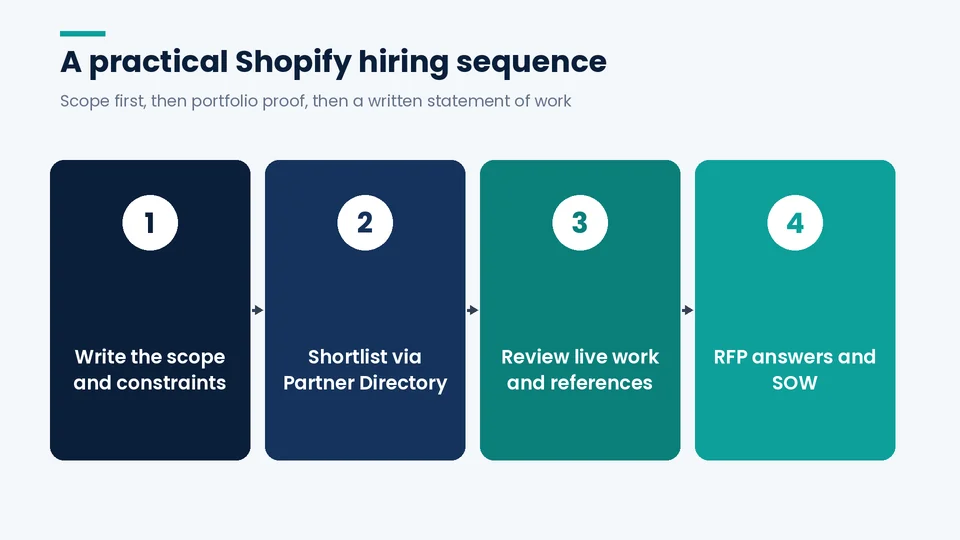
Hiring well starts with matching the skill set to the job. A theme tweak is not a Plus checkout rebuild, and a migration is not a homepage redesign. At PROSeCommerce, part of PROS Global, a San Diego Shopify and Magento agency, we see the best outcomes when merchants write a clear scope before they talk to freelancers or agencies. This guide covers how to evaluate candidates, which skills to require, red flags to avoid, and RFP questions that surface real experience.
Official discovery paths include Shopify’s Partner Directory, where you can filter by service, location, budget, and partner tier. Directory listing is one signal among many; it is not a substitute for references and a technical review of past work.
Freelancer, small studio, or larger agency
Choose the engagement model from risk and coordination needs, not from a preference for “agile” branding. Freelancers suit narrow, well-specified tasks. Agencies suit multi-role projects with design, development, QA, and launch support.
| Model | Best for | Watch-outs |
|---|---|---|
| Solo freelancer | Theme edits, small app installs, bug fixes | Vacation gaps, single point of failure, limited Plus depth |
| Small studio (2–8 people) | New theme builds, mid-size migrations, ongoing retainers | Capacity during peak seasons |
| Full-service agency | Plus builds, complex integrations, multi-market launches | Higher overhead; insist on named team and clear change-order rules |
| Specialist Plus partner | Checkout extensibility, B2B, Hydrogen, enterprise mid-office | Overkill for a Basic-plan brochure store |
Shopify’s Partner Program uses tiers such as Select, Plus, Premier, and Platinum on the merchant-facing directory filters (as described in Shopify’s Partner Directory materials as of 2025–2026 updates). Treat tier as a signal of commercial history with Shopify, then still verify the people who will touch your store.
If you already know you need build help rather than a hiring tutorial, the Shopify development services page on prosecommerce.com outlines how a senior Shopify team scopes theme, app, and migration work.
Skills checklist by project type
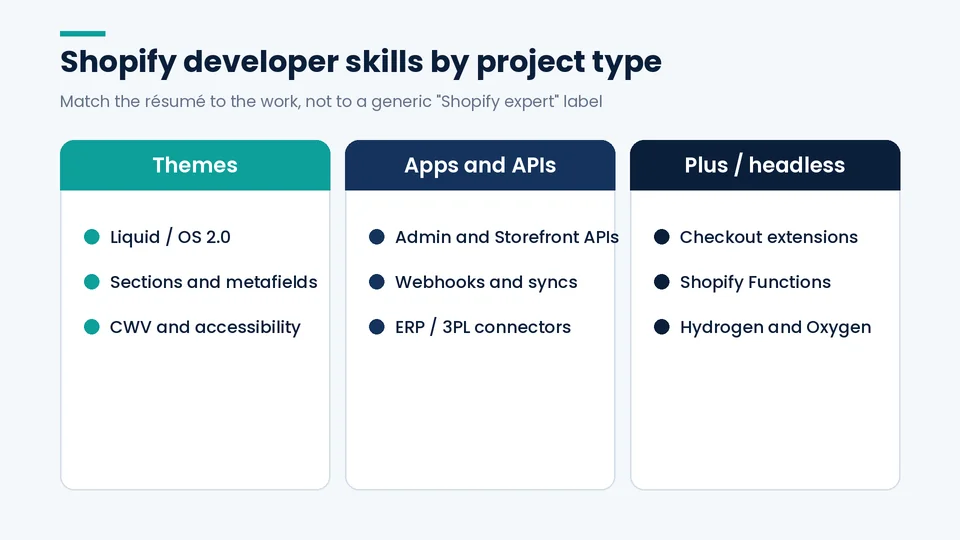
Ask for proof against the skills your project actually uses. Portfolios full of homepage mockups do not prove ERP sync experience.
Theme and Online Store 2.0
- Liquid, JSON templates, sections, and blocks
- Theme performance: script budgets, image strategy, Core Web Vitals
- Accessibility and responsive QA
- Metafields and metaobjects for content models
Apps and integrations
- Shopify Admin and Storefront APIs
- Webhooks, retry logic, and idempotent syncs
- Familiarity with common ERPs, 3PLs, subscription, and CDP tools
- App review and security basics if they ship public apps
Plus and enterprise
- Checkout UI extensions and Shopify Functions
- B2B catalogs and company locations
- Expansion stores and multi-market setups
- Higher API rate-limit patterns and middleware design
Headless
- Hydrogen and Oxygen deployment flows documented on Shopify’s Hydrogen docs
- Storefront API, caching, and SEO parity for headless routes
- Clear reason headless is required versus a well-built Online Store theme
Migrations
- Data mapping for products, variants, customers, gift cards, and historical orders
- Redirect strategy and SEO preservation
- Parallel run and cutover planning
For migration-heavy scopes, point candidates at the complexity in our Magento to Shopify migration checklist and WooCommerce to Shopify migration checklist so estimates account for redirects and data cleanup, not only theme polish.
How to evaluate portfolios and demos
A useful portfolio shows live URLs, the merchant’s constraints, and what the developer owned. Screenshots alone are weak evidence. Ask which apps they recommended versus custom-built, how they handled checkout limits on non-Plus plans, and what broke after launch.
During a paid discovery or technical interview:
- Walk a recent store and have them explain theme architecture.
- Ask for a short Loom or live session debugging a Liquid or API issue.
- Request a sample estimate with assumptions written down.
- Confirm who does design, development, QA, and project management.
- Verify collaborator access practices and how they hand back the store.
Check reviews on the Partner Directory profile when present, but also call two references. Ask references about communication under deadline pressure and about post-launch support, not only about launch-day polish.
Red flags when hiring Shopify help
Walk away early when you see these patterns. They predict budget overruns more often than a slightly higher hourly rate does.
- Guaranteed ranking or revenue promises. No honest developer controls Google or your conversion rate wholesale.
- No Shopify admin collaborator workflow. Sharing the store owner password is a security failure.
- One flat price with no assumptions. Serious scopes list what is in, out, and estimated.
- Theme fork with no documentation. You inherit unmaintainable code.
- Pushing Plus or headless without a business reason. Sometimes Advanced plus a good theme is enough; see our Shopify Advanced vs. Plus comparison when that debate appears.
- Cannot explain Liquid versus Hydrogen trade-offs. If they cannot say when headless is unnecessary, they may oversell it.
- Outdated fee or plan claims. Anyone still quoting retired plan names or old Plus sticker prices has not read Shopify’s current pricing.
Also watch for agencies that only show enterprise logos without naming the workstream they owned. Ask what percentage of the build their team delivered.
RFP questions that separate experts from generalists
Send these questions in writing. Strong partners answer specifically; weak ones reply with buzzwords.
- Which Shopify plan do you recommend for this scope, and why?
- Will this build stay on Online Store 2.0, or do you propose Hydrogen? What forces that choice?
- Which parts need a custom app versus an existing App Store app?
- How do you handle checkout requirements if we are not on Plus?
- What is your redirect and SEO plan for a migration?
- Who is the day-to-day contact, and what is their Shopify experience?
- How do you price change orders when requirements shift?
- What does 30/60/90-day post-launch support include?
- Can you share two contacts from similar catalog size and complexity?
- How do you document theme customizations for the next developer?
Add commercial questions: payment schedule, ownership of code and design files, and whether unused discovery hours roll forward. For performance-sensitive storefronts, ask how they will measure LCP and what budget they set for third-party scripts; our speed guide lists the failure modes we see most often.
Cost planning ranges (not quotes)
Shopify development pricing varies by country, seniority, and scope. Treat the figures below as general industry planning ranges for US-facing work in 2026, not as PROSeCommerce quotes or guarantees.
- Small theme customization packages often land in the low thousands of dollars.
- Full custom theme builds commonly sit in the mid four to five figures depending on templates and integrations.
- Complex migrations with ERP sync and large redirect maps can reach higher five figures or more.
- Plus checkout and B2B programs are scoped as projects, not hourly guesswork.
- Monthly retainers for ongoing improvements often beat restarting a hunt for help every quarter.
Always ask for a written statement of work. If a bid is far below peers, assume missing QA, missing redirects, or missing post-launch support until proven otherwise.
Working relationship after you hire
Good Shopify work continues after launch day. Agree on a backlog process, staging discipline, and who approves app installs. Limit admin access with collaborator accounts and remove access when the engagement ends.
Document metafield definitions, custom app credentials ownership, and theme version history in a shared place your team controls. When plan upgrades come up later, revisit Shopify plans with your developer so staff limits and checkout needs stay aligned with the subscription you pay for.
Strong delivery teams treat handoff documentation as part of delivery, not an optional extra. That habit is what lets a merchant change partners later without rebuilding tribal knowledge from scratch.
Theme developers vs app developers vs strategists
Not every “Shopify expert” is interchangeable. Theme developers live in Liquid, CSS, and UX polish. App developers live in APIs, databases, and auth. Strategists and solutions architects translate business rules into a plan tier, app stack, and phased roadmap. Many projects need at least two of those roles.
When one person claims they will design, develop, integrate ERP, and run SEO alone on a fixed bid, ask how QA and contingency are handled. For SEO-heavy launches, make sure someone owns technical SEO tasks from our Shopify SEO checklist rather than leaving robots rules and canonicals as an afterthought.
If your catalog still lives on WooCommerce or Magento, include a merchant-side data owner in the project. Developers can map fields, but only your team can decide which legacy products, tags, and customer records deserve to move.
Frequently asked questions about hiring Shopify developers
Should I hire a Shopify freelancer or an agency?
How much does a Shopify developer cost in 2026?
What skills should a Shopify Plus developer have?
Is the Shopify Partner Directory enough to choose a partner?
Do I need a Hydrogen developer for every custom storefront?
What questions should I ask before signing?
Hire for proof, not promises
The best Shopify developers show live work, write clear assumptions, and tell you when not to build custom. Start with a scoped RFP, use the Partner Directory as one input, and score candidates against the skills your project actually needs.
If you want help turning a rough idea into a buildable brief, or you need an experienced Shopify team for theme, app, Plus, or migration work, reach out through PROSeCommerce’s Shopify development services. Bring your plan tier, must-have integrations, and launch date. That is enough to start an honest estimate.